


Filing a Green Card Through Marriage While on a Tourist Visa: Is It Safe?
The question of whether one safely files for a green card through marriage while in the United States on a tourist visa is one of the most difficult in immigration law. The answer is nuanced.
- Entering the U.S. on a B-2 tourist visa with the preconceived intent to marry a U.S. citizen and apply for a green card is a violation of immigration law; specifically, visa fraud.
- However, entering with the genuine intent to visit, and then—due to a change in circumstances—spontaneously deciding to marry and stay, is a legally recognized path to permanent residence for immediate relatives of U.S. citizens.
The hard truth is that the line between a permissible change of heart and impermissible visa fraud depends entirely on your state of mind when you spoke to the officer at the border. U.S. Citizenship and Immigration Services (USCIS) will scrutinize your actions to determine that intent. While this scrutiny is high in recent times, couples with authentic relationships and honest timelines continue to successfully complete this process.
At Brooks Law Firm, we help families present the legitimacy of their decisions clearly and protect their future together in the U.S.
If you are currently in the United States on a tourist visa and are considering marriage, or if you have already married and are now unsure of the next steps, call us at (617) 245-8090 for a consultation with a dedicated green card attorney.
Key Takeaways for Filing a Green Card on a Tourist Visa
- Proving spontaneous intent is everything. The U.S. government must be convinced that your decision to marry and immigrate was made after you arrived, not before.
- The 90-day rule is a guideline, not a guarantee. Filing for a green card within 90 days of arrival creates a legal presumption of visa fraud, but waiting past 90 days does not erase risk if other evidence suggests you had a preconceived plan.
- This path is only for spouses of U.S. citizens. USCIS forgives visa overstays for immediate relatives of citizens, but not for spouses of green card holders, who face a much more dangerous and restrictive process.
The Core Legal Concept: Preconceived Intent vs. Spontaneous Decision

To understand the risk, you first need to understand the nature of the B-2 tourist visa. When you were granted that visa and admitted at the border, you made a promise to the U.S. government that you had non-immigrant intent. Simply put, you affirmed that your stay was temporary and that you would return to your home country. Filing for a green card is the ultimate expression of immigrant intent, directly contradicting the terms of your entry.
This is where the legal distinction between a spontaneous decision and a preconceived plan becomes the central issue. U.S. immigration law allows a person who entered legally to apply for a green card from within the country through a process called Adjustment of Status (AOS) under INA §245(a). For spouses of U.S. citizens, this pathway is available even if their tourist visa expires. The key, however, is that the intent to immigrate must have formed after a lawful entry.
Consider these two scenarios:
- A Permissible, Spontaneous Decision: You came to the U.S. to visit your partner and meet their family for a few weeks. During the trip, your partner proposes, or perhaps a sudden family health crisis makes the thought of leaving unbearable. You decide, together, that you cannot be apart, so you get married and decide to file for adjustment of status. Your intent changed after you arrived.
- An Impermissible, Preconceived Intent: Before you even booked your flight, you and your partner had planned to marry in the U.S. and file for a green card. You packed items that suggest a permanent move, sold your property back home, and quit your job. When the border officer asked the purpose of your trip, you said “tourism” while privately planning to immigrate. This is willful misrepresentation.
USCIS does not have the ability to read minds. Instead, they examine evidence. A finding of willful misrepresentation leads to a lifetime bar from the United States under INA §212(a)(6)(C)(i). You must present your case honestly and with compelling documentation.
The 90-Day Rule: Myth vs. Reality
You may have heard about a 90-day rule online, and it is a concept that causes a great deal of confusion and anxiety. This is not a formal law passed by Congress but is instead guidance found in the U.S. Department of State’s Foreign Affairs Manual (FAM).
It acts as a tool for consular officers—and, by extension, USCIS adjudicators—to presume whether a person misrepresented their intentions upon entering the United States.
Here is how the 90-day rule generally works:
- Conduct Within 90 Days: If you marry a U.S. citizen and file for adjustment of status within 90 days of arriving on a tourist visa, the government will presume that you had a preconceived intent to immigrate. This doesn’t mean your case is automatically denied, but the burden of proof is now on you to overcome this negative presumption. You must provide substantial evidence that your intent changed unexpectedly after your arrival.
- Conduct After 91 Days: If you wait until after 90 days have passed since your entry to marry or file, the legal presumption of misrepresentation disappears. The government still questions your original intent based on other evidence, but they no longer have the benefit of this automatic presumption against you.
Why Waiting Until Day 91 Is Not a Magic Shield
Many people mistakenly believe that waiting until the 91st day erases all risk. This is not true.
While the legal presumption is gone, a USCIS officer will still conduct a thorough review of your entire timeline and circumstances. For example, if you have emails with your partner from six months before your trip discussing your wedding and green card plans, filing on day 91 will not protect you. USCIS is not bound by the 90-day rule in the same way Department of State officials are, but it remains a powerful analytical framework they use to assess your good faith.
Trying to game the system by strategically waiting is a risky approach. A much safer strategy is to have an open conversation with an immigration attorney to assess the actual facts of your case and build an honest, well-documented application, regardless of the exact timing.
Assessing the Risks
Filing for a green card from a tourist visa is not a decision to be taken lightly, as the consequences of a denial based on visa fraud are severe. A fraud finding permanently bars you from ever entering the United States again.
These are the primary risks you face:
- Finding of Visa Fraud: If USCIS determines you willfully misrepresented your intent at the port of entry, your adjustment of status application will be denied, and you will likely be placed in removal (deportation) proceedings. As mentioned, this results in a lifetime ban.
- Abandonment of Application: Once you file for adjustment of status, you cannot leave the United States until you receive a special travel permit called Advance Parole. If you leave without it, USCIS will consider your application abandoned, and you will almost certainly not be allowed back into the country.
- Visa Cancellation at Entry: Even if you don’t file any paperwork, if a Customs and Border Protection (CBP) officer at the airport suspects you have immigrant intent (for example, by finding wedding plans or a resume in your luggage), they may cancel your tourist visa and force you to withdraw your application for admission, returning you on the next flight home.
Immediate Relatives vs. Other Family Members
A significant factor in mitigating risk is the applicant’s relationship to the U.S. citizen. Spouses of U.S. citizens are considered immediate relatives. This special designation comes with a unique form of forgiveness.
For immediate relatives, USCIS will overlook an overstay of a visa and any unauthorized work, provided that the initial entry was lawful. The lawfulness of that entry hinges on your intent. If the entry was fraudulent, this forgiveness does not apply.
This is much riskier for spouses of Green Card holders (lawful permanent residents). They are in the F2A preference category and must maintain lawful immigration status at all times to be eligible to adjust. If their tourist I-94 expires before they file, they typically are unable to adjust their status from within the U.S.
Proving Your Narrative with Evidence
In recent times, USCIS is placing greater emphasis on fully documented applications. Filings that are hastily put together are more likely to face a Request for Evidence (RFE), causing significant delays. To succeed, you must proactively build a case that tells a clear, consistent, and believable story of a spontaneous change in life plans.
USCIS officers are trained to look for red flags that indicate preconceived intent. You need to provide evidence that demonstrates the opposite.
Evidence USCIS Will Scrutinize:
- Your Ties to Your Home Country: Strong evidence includes proof that you maintained your apartment lease, kept your job, or still owned property and vehicles back home. This shows you had a life to return to. Conversely, evidence that you sold your assets or quit your job before your trip would be damaging.
- The Timing of Major Life Events: Did you purchase a wedding dress or rings before traveling to the U.S.? Did you hire a wedding planner or book a venue months in advance? This evidence undermines the claim that your marriage was a spontaneous decision.
- A Documented Change in Circumstances: The strongest cases typically point to a specific “life event” that occurred after arrival. This could be a surprise pregnancy, a sudden illness in the family that requires your presence, an unexpected and compelling job offer for the U.S. citizen spouse, or simply a deeply emotional realization that you could not go through with the planned separation.
Be prepared for a Stokes or marriage fraud interview. Because this filing scenario carries a higher suspicion of fraud, USCIS is more likely to call you and your spouse in for an interview where you are separated and asked detailed questions about your relationship and life together. Discrepancies in your answers could lead to a denial.
Procedural Steps: Filing From Within the U.S.
If, after careful consideration, you determine this is the correct path for you, the process involves filing several forms together, known as concurrent filing.
The core of the application package includes:
- Form I-130, Petition for Alien Relative: This form is filed by the U.S. citizen spouse to establish the validity of your marriage.
- Form I-485, Application to Adjust Status: This is your application for the green card.
Along with these, you will almost always file:
- Form I-765, Application for Employment Authorization: This requests a work permit (EAD) that allows you to work legally while the green card application is pending.
- Form I-131, Application for Travel Document: This requests an Advance Parole document, which allows you to travel internationally without abandoning your I-485 application.
A recent update is the emphasis on submitting Form I-693, Report of Medical Examination and Vaccination Record, with the initial application package. Per current USCIS policy, including the sealed medical exam from the outset helps to avoid processing delays and potential RFEs down the line.
Once the package is filed, you will receive receipt notices, and you will enter a period of authorized stay. This means that even if your I-94 from your tourist entry expires, you remain in the U.S. lawfully while your adjustment application is pending.
When You Should NOT File from a Tourist Visa
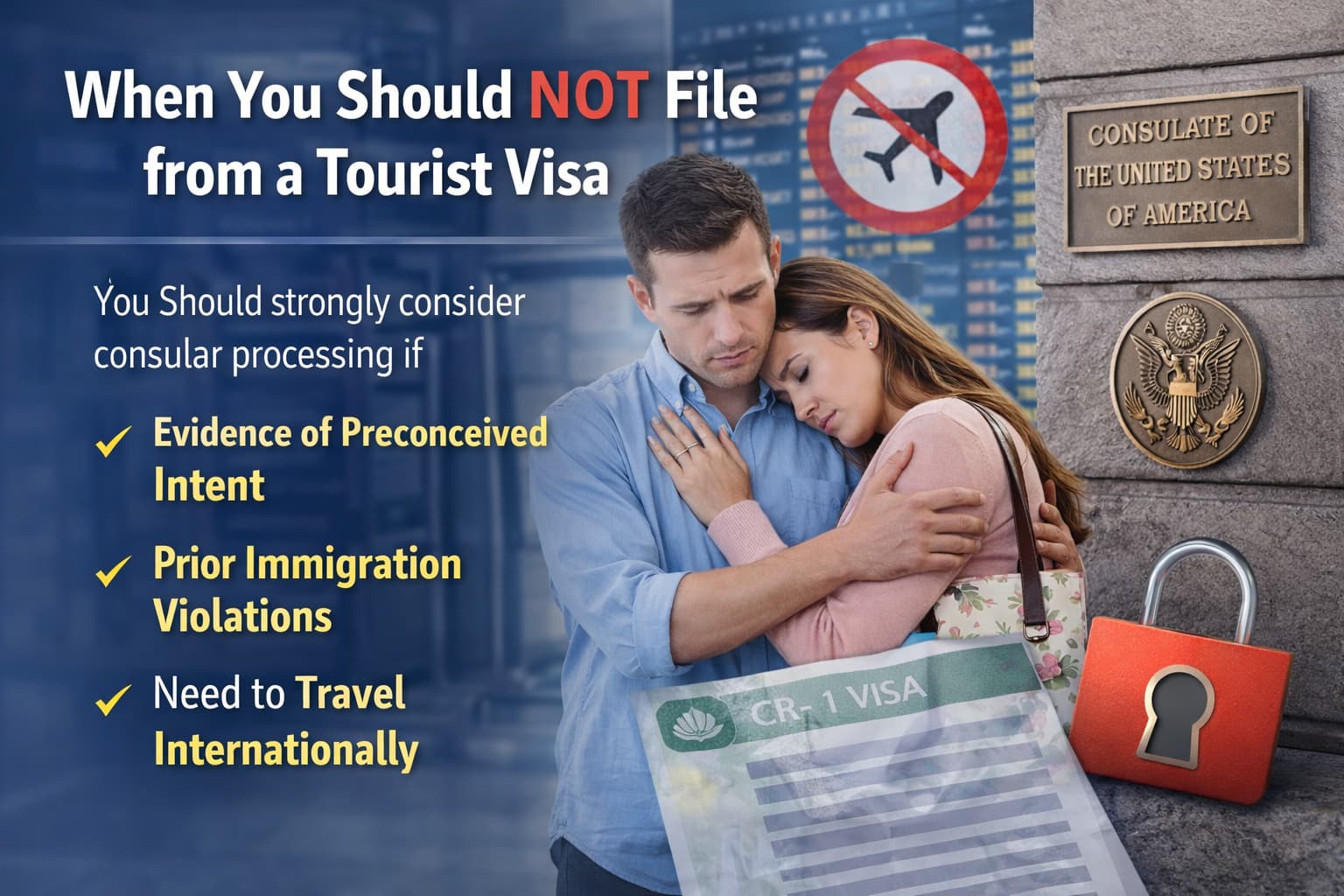
This pathway is not right for everyone. In some situations, attempting to adjust status from a tourist visa is the wrong strategy. The safer, more appropriate alternative is for the foreign spouse to return to their home country and complete the process through a U.S. consulate abroad, known as consular processing for a CR-1 or IR-1 spousal visa.
You should strongly consider consular processing if:
- You Have Clear Evidence of Preconceived Intent: If you have a digital or paper trail that clearly shows you planned to immigrate before you entered the U.S., it is far better to go through the proper channels from abroad than to risk a finding of fraud.
- You Have Prior Immigration Violations or a Criminal Record: Certain past issues make you ineligible to adjust status from within the U.S. These issues must be addressed, and often waived, through a consulate.
- You Need to Travel Internationally: The Advance Parole document takes many months to be approved. If you are unable to be stuck in the U.S. for an extended period for work or family reasons, consular processing is the better choice.
For couples who are engaged but not yet married, the K-1 Fiancé Visa is the process designed specifically for this situation. It allows the foreign fiancé to enter the U.S. with the express intent to marry and then apply for a green card.
FAQ: Filing for a Green Card on a Tourist Visa
My I-94 expires in 2 weeks, but we just got married. Is it too late to file?
Generally, no. For spouses of U.S. citizens, an overstay is typically forgiven if you file the adjustment of status application. However, we recommend filing before your authorized stay expires to avoid accumulating any period of unlawful presence. You should act quickly.
Can I leave the U.S. to visit family while my Green Card application is pending?
You absolutely cannot leave without first receiving an Advance Parole travel document. If you depart the U.S. before your I-131 application for Advance Parole is approved, USCIS will consider your green card application abandoned, and you may be barred from re-entry.
We married 30 days after I arrived. Should we wait to file until day 91?
This is a strategic question that requires legal advice. Waiting does not change the fact that the marriage occurred within the 90-day window. We advise consulting with an attorney to determine whether to file immediately with a strong explanation and evidence of your changed intent, rather than trying to wait out the clock, which sometimes appears evasive.
What if I worked remotely for my foreign employer while on my tourist visa before we filed?
Any unauthorized work is a violation of your tourist visa status. While USCIS may forgive this for the spouse of a U.S. citizen applying for adjustment of status, you must disclose this fact honestly on your application. Failing to do so constitutes another form of misrepresentation.
Does this process work if my spouse is a Green Card holder, not a Citizen?
It is far more dangerous and generally not possible. Spouses of Green Card holders are in a family preference category (F2A) and must maintain their lawful nonimmigrant status right up until they file their I-485. Since a visa number is not immediately available, your tourist visa would expire long before you become eligible to file, making you ineligible for adjustment.
Protect Your Future Together
We handle difficult adjustment of status cases nationwide, helping couples present their true story to USCIS with clarity and precision. The stakes are too high to handle this process based on advice from online forums or well-meaning friends.
If you are unsure about your eligibility for filing a green card through marriage while on a tourist visa or worried about the 90-day rule, call Brooks Law Firm today at (617) 245-8090. Let us help you start your life in the United States safely.


