


Green Card Through Marriage on Tourist Visa: Rules and Risks
How to File a Green Card Through Marriage on a Tourist Visa
If you are in the United States on a tourist visa and you have married a U.S. citizen, or you are thinking about it, the question at the center of everything is whether you can apply for a green card without leaving the country. The short answer is that you may be able to, but the process has become more difficult than it was even a year ago, and the consequences of getting it wrong are serious.
A new policy memorandum from U.S. Citizenship and Immigration Services (USCIS), the federal agency that processes green card applications, went into effect in May 2026. It directs officers to treat the process of applying for a green card from inside the United States (known as adjustment of status) as an extraordinary form of relief, not a routine step. That policy applies with special force to people who entered on tourist visas, because a tourist visa is a promise that your stay is temporary. Filing for a green card is the opposite of temporary, and USCIS is now looking more closely at whether that contradiction should count against you.
None of this means the path is closed. Couples with genuine relationships and honest timelines continue to complete this process. But it does mean that the filing-date decisions, the evidence you present, and the way you handle the government’s scrutiny all matter more than they used to.
If you are in the United States on a tourist visa and considering marriage, or if you have already married and are unsure of the next steps, call Brooks Law Firm at (617) 245-8090 for a consultation with a dedicated green card attorney.
The Line Between a Genuine Change of Plans and Visa Fraud
The core legal issue is intent. When you entered the United States on a B-2 tourist visa, you told the government that your stay was temporary and that you would return home. If your intent changed after you arrived, because of an unexpected proposal, a family emergency, or a realization that you could not go through with a planned separation, the law allows you to adjust your status from inside the country. If your intent was always to stay and you misrepresented that at the border, the government treats that as fraud.
USCIS cannot read your mind, so it examines the evidence. The strongest cases point to a specific event or change in circumstances that happened after arrival. Think of it this way: a couple who came to visit family and then received an unexpected pregnancy diagnosis has a very different story from a couple who sold their apartment abroad, packed their belongings, and told the border officer they were tourists.
A finding that you committed willful misrepresentation triggers a ground of inadmissibility under the immigration statute that does not expire with time. However, it is not necessarily permanent. A waiver exists under INA 212(i) for applicants who have a U.S. citizen or lawful permanent resident spouse or parent and can demonstrate that denying admission would cause extreme hardship to that qualifying relative. It is important to understand that children, even U.S. citizen children, do not count as qualifying relatives for this particular waiver, so the waiver is not available to everyone. The waiver is also discretionary, meaning USCIS can deny it even when the requirements are met.

How the 90-Day Guideline Actually Works
You may have heard about a 90-day rule, and it causes more confusion than almost anything else in this area of law. It is not a federal statute. It is a guideline published in the U.S. Department of State’s Foreign Affairs Manual (FAM), which is the internal handbook for consular officers who process visas at U.S. embassies and consulates abroad. USCIS, which handles adjustment of status applications inside the country, has adopted the same analytical framework, but the FAM is not binding law on USCIS adjudicators.
Here is what the guideline says in practice. If you marry a U.S. citizen and file for a green card within 90 days of entering on a tourist visa, the government presumes that you misrepresented your intentions when you entered. That presumption is rebuttable, meaning you can overcome it, but the burden falls on you to prove that your plans genuinely changed after you arrived.
If you file after 90 days, that presumption drops away. But the government can still question your original intent based on other evidence. Emails, travel records, social media posts, and the timing of major life decisions all remain fair game regardless of how long you waited.
Waiting until the 91st day is not a strategy. A USCIS officer reviewing your case will look at the full picture, and an applicant who appears to have deliberately waited just past the 90-day mark may draw more suspicion, not less. The safer approach is to speak with an immigration attorney early and build a case based on the truth of your situation, regardless of timing.
USCIS Now Treats Adjustment of Status as Extraordinary Relief
This is the development that has changed the landscape most significantly for couples in this situation. In May 2026, USCIS issued Policy Memorandum PM-602-0199, which directs officers to treat adjustment of status as a discretionary benefit and an act of administrative grace rather than a routine administrative step. The memo instructs officers to consider the totality of circumstances when deciding an adjustment application. Applicants must affirmatively demonstrate that they merit a favorable exercise of discretion.
The memo does not create new eligibility rules, and it does not prohibit anyone from filing. But it means that meeting the technical requirements is no longer enough on its own. For someone who entered on a tourist visa and is now applying for a green card, two things now stack against them: the 90-day analytical framework and the heightened discretionary standard. Officers are specifically directed to weigh conduct that is inconsistent with the purpose of a temporary admission, which is exactly what a tourist-to-green-card filing looks like.
What this means in practical terms is that the evidence package you submit matters more than ever. Strong ties to a genuine relationship, a documented change in circumstances, and a clean immigration history are the kinds of positive equities that help an officer exercise discretion in your favor. A thin or hasty filing is far more likely to trigger a Request for Evidence (RFE), which is a written request from USCIS asking for additional documentation, and that delay can stretch an already long process by months.
A Filing-Date Decision That May Affect Your Case
A separate change is also relevant if you are planning to file soon. On July 20, 2026, the Department of Homeland Security published a final rule in the Federal Register rescinding the 2022 public charge regulation, effective September 18, 2026. Public charge is the government’s assessment of whether an applicant is likely to depend on government assistance.
The date you file determines which standard applies to your case. Applications postmarked or electronically submitted before September 18, 2026, are evaluated under the 2022 rule, which limited the types of benefits USCIS could consider. Applications filed on or after that date fall under the new standard, which gives officers broader discretion to weigh all relevant factors on a case-by-case basis. USCIS will also require a new edition of Form I-485 beginning on that date and will reject older editions. One reassuring point: even under the new standard, benefits received before September 18, 2026, will still be evaluated under the 2022 rule’s framework.
If you are considering filing and the timing is flexible, this deadline is worth discussing with an attorney, because it may affect which standard your application is judged against.
This Path Works for Spouses of U.S. Citizens Who Entered Lawfully
This process is available to spouses of U.S. citizens who entered the country lawfully. As a spouse of a U.S. citizen, you are classified as an immediate relative under immigration law, and that classification carries important protections.
For immediate relatives, USCIS forgives a visa overstay and any unauthorized employment, as long as the original entry was lawful. This protection comes from the statute itself, so if your tourist visa authorization has expired but you entered legally, that overstay alone does not make you ineligible to adjust your status.
The situation is different for spouses of lawful permanent residents (green card holders). Those applicants fall into the F2A preference category. As of August 2026, the F2A category has been current on the Visa Bulletin’s Dates for Filing chart, meaning USCIS is currently accepting adjustment filings in that category. However, these applicants are not immediate relatives and do not receive the same statutory protections. Their path to adjusting status from a tourist visa is more constrained and more risky, and the analysis depends heavily on individual circumstances.
People who entered the United States without inspection (without going through a port of entry) generally cannot adjust status at all, with limited exceptions. One narrow exception is INA 245(i), which allows adjustment for people who had a qualifying immigrant petition or labor certification filed on their behalf on or before April 30, 2001. That provision expired over 25 years ago and applies only to grandfathered beneficiaries, but it is still relevant in some cases.
The Forms in Your Filing Package and What Each One Does
If you and your attorney decide that adjustment of status is the right path, the process involves filing several forms together in what is called concurrent filing.
Form I-130, Petition for Alien Relative. Your U.S. citizen spouse files this form to establish the validity of your marriage. USCIS reviews whether the marriage is legally valid and whether it was entered into in good faith.
Form I-485, Application to Register Permanent Residence or Adjust Status. This is your application for the green card. It is where USCIS evaluates your admissibility, your eligibility, and whether you merit a favorable exercise of discretion.
Form I-765, Application for Employment Authorization. This requests a work permit that allows you to work legally while your green card application is pending.
Form I-131, Application for Travel Document. This requests an advance parole document, which is a travel permit that allows you to leave and re-enter the United States without abandoning your pending green card application. Do not leave the country without this document. If you depart before it is approved, USCIS considers your green card application abandoned.
Form I-864, Affidavit of Support. Your U.S. citizen spouse (and a joint sponsor, if needed) files this to demonstrate that you are not likely to become a public charge. This form will take on added significance once the new public charge standard takes effect on September 18, 2026.
Form I-693, Report of Medical Examination and Vaccination Record. USCIS policy encourages submitting the sealed medical examination with the initial filing package to avoid processing delays.
Once USCIS accepts the package, you enter a period of authorized stay. That means that even if your tourist visa authorization has expired, unlawful presence stops accruing while your application is pending. It is worth understanding, though, that a pending adjustment application does not give you lawful immigration status. It prevents the unlawful-presence clock from running, but it is not the same as holding a visa or a green card.
There is one more consequence of this path that many applicants do not expect. If you have been married for less than two years at the time your green card is approved, you will receive a two-year conditional green card rather than a standard ten-year card. Before that conditional card expires, you and your spouse must file Form I-751, Petition to Remove Conditions on Residence, within the 90-day window immediately before the two-year anniversary. Missing that window can result in the loss of your permanent resident status. If the marriage has ended by that point, a waiver of the joint-filing requirement may be available, but the process is more demanding.
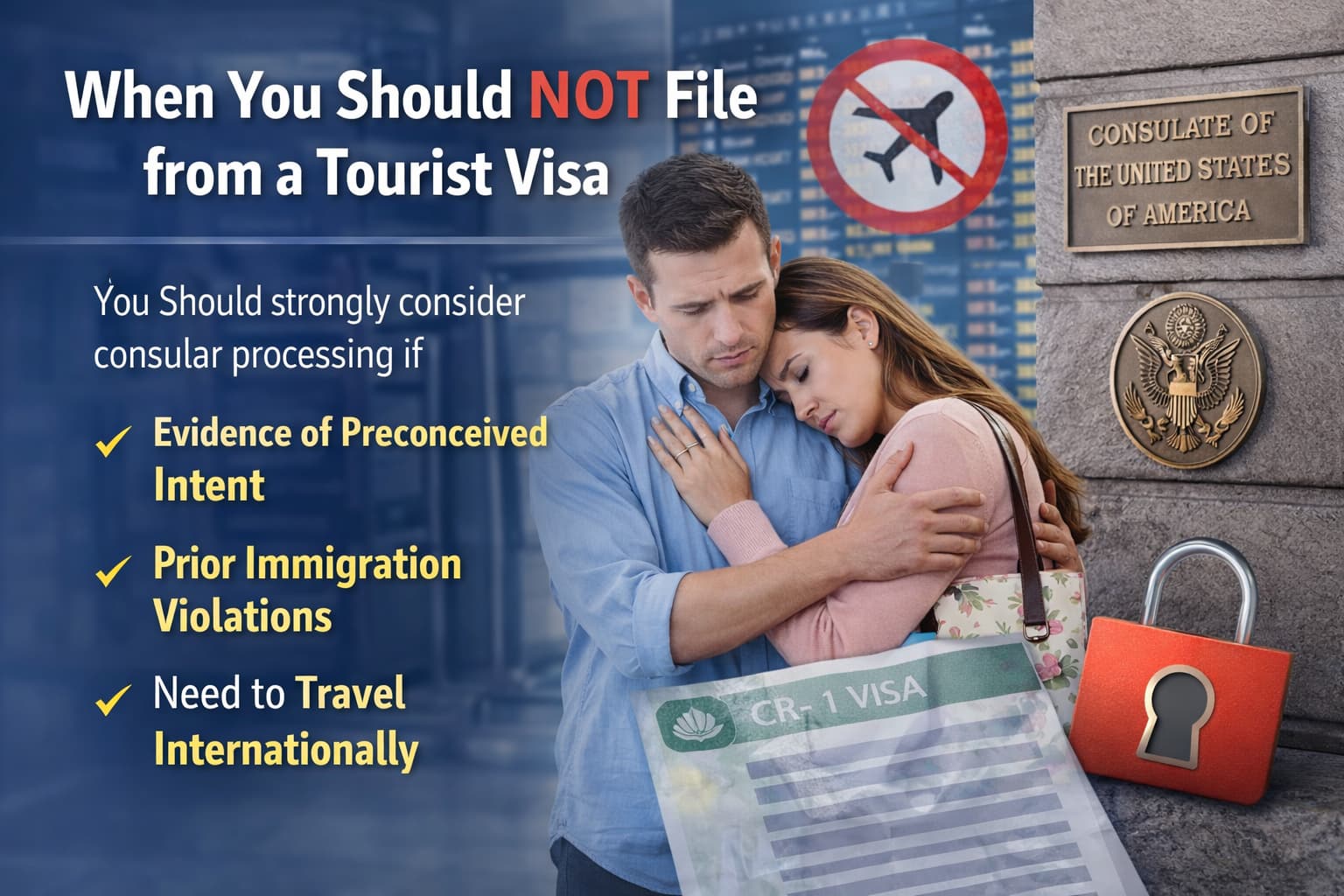
When Consular Processing May Be the Safer Path
Adjustment of status is not the right choice for everyone, and under the current policy environment, there are situations where the safer strategy is for the foreign spouse to return home and apply for a green card through a U.S. consulate abroad. This is called consular processing, and the visa category is called a CR-1 (conditional resident, if married less than two years) or IR-1 (immediate relative, if married two years or more).
You should consider consular processing if there is clear evidence that you planned to immigrate before you entered the United States, if you have prior immigration violations that create bars to adjustment, or if you cannot remain in the country for the time it takes to process the application without advance parole.
For couples who are engaged but not yet married, the K-1 fiancé visa is the process specifically designed for this situation. It allows the foreign fiancé to enter the United States with the express intent to marry and then file for adjustment of status.
Frequently Asked Questions
My tourist visa authorization expires in two weeks and we just got married. Can I still file?
Yes. As the spouse of a U.S. citizen, you are an immediate relative, and the statute forgives a visa overstay as long as your original entry was lawful. Filing before the authorization expires is preferable, but filing after is still possible. Speak with an attorney as soon as you can to get the application prepared.
Can I leave the United States while my green card application is pending?
Not without an approved advance parole travel document (Form I-131). If you leave before it is approved, USCIS treats your green card application as abandoned, and you may not be allowed back into the country.
We married 30 days after I arrived. Should we wait until after 90 days to file?
This is a question that depends entirely on the facts of your case. Waiting does not change the fact that the marriage happened within the 90-day window, and a strategic delay can sometimes look evasive. In many cases, filing promptly with a strong evidence package and a clear explanation of the change in circumstances is a better approach than waiting. An attorney can help you decide which path makes more sense for your situation.
Does this process work if my spouse is a green card holder, not a U.S. citizen?
It is more difficult. Spouses of green card holders are in the F2A preference category and do not receive the same statutory protections as immediate relatives. As of August 2026, USCIS has been accepting adjustment filings in the F2A category, but the analysis is more complex and the risks are higher. Speaking with an immigration lawyer is important before taking any step.
What if I worked remotely for my foreign employer while on my tourist visa?
Any unauthorized work is a violation of your tourist visa status. For the spouse of a U.S. citizen adjusting status, USCIS may forgive this under the immediate relative exemption, but you must disclose it honestly on your application. Failing to disclose it is a separate form of misrepresentation.
What to Do Now
If you are on a tourist visa and considering a marriage-based green card, or if you have already married and are unsure of the next steps, the most important thing you can do is get a case-specific assessment from an attorney before you file. The stakes have always been high in this area of law, and the May 2026 policy shift has made the discretionary side of the process more demanding.
Reach out to Brooks Law Firm today to schedule a free consultation, and we will give you an honest look at where your case stands and what your options are. Call (617) 245-8090.


