


How Do You Prove Premises Liability?
If you were injured on someone else’s property, you might wonder how you can hold the owner responsible. To prove premises liability, you must show that the property owner was careless in maintaining their property and that their carelessness directly caused your injuries. This involves gathering specific evidence to build a strong case that demonstrates the owner’s legal responsibility for the harm you suffered.
The process requires establishing four key legal elements, from the owner’s initial duty to keep you safe to the actual damages you incurred.
Reach out to an experienced personal injury lawyer to help prove premises liability—contact us today for a free consultation.
Key Takeaways about Proving Premises Liability
- A successful premises liability claim establishes that a property owner’s negligence led to a person’s injuries.
- The claim must prove four elements: the owner had a duty of care, they breached that duty, the breach caused the injury, and the person suffered actual damages.
- Evidence is critical and can include photos of the hazard, incident reports, witness statements, and medical records.
- Massachusetts law has specific rules regarding different types of property visitors and conditions like snow and ice.
- The type of damages that may be recovered can include medical expenses, lost income, and compensation for pain and suffering.
Understanding the Basics of Premises Liability in Massachusetts

Premises liability is a legal concept that holds property owners and occupiers accountable for accidents and injuries that occur on their property. The core idea is that owners have a responsibility to maintain a reasonably safe environment for people who visit. When they fail to do so, and someone gets hurt as a result, the owner may be considered negligent.
In Massachusetts, a property owner’s responsibility depends on why the person was on the property. The law classifies visitors into three main categories:
- Invitee: This is someone invited onto the property for the owner’s commercial benefit, like a customer in a store, a diner in a restaurant, or a fan at a Red Sox game at Fenway Park. Owners owe invitees the highest duty of care. They must regularly inspect the property for hidden dangers and either fix them or clearly warn people about them.
- Licensee: This is a social guest, like a friend invited to a home for dinner or a family member visiting. The property owner must warn a licensee of any known dangers that the guest is unlikely to discover on their own.
- Trespasser: This is someone who enters the property without permission. Generally, property owners do not owe a duty to keep trespassers safe from harm. However, they cannot intentionally injure a trespasser. An important exception applies to children; owners must take reasonable steps to protect trespassing children from “attractive nuisances,” which are dangerous conditions that might attract a child’s curiosity, like an unfenced swimming pool.
Understanding these distinctions is the first step in determining the property owner’s level of responsibility for your injury.
The Four Essential Elements You Must Prove
To successfully prove a premises liability claim in Massachusetts, your case must establish four specific points. Think of these as building blocks—if one is missing, the entire claim can fall apart. A legal professional works to demonstrate that each of these elements is supported by evidence.
A Duty of Care Existed
First, you must show that the property owner owed you a “duty of care.” This is a legal obligation to act with reasonable caution to prevent foreseeable harm to others. For a Boston shopkeeper, this duty includes mopping up spills promptly, or for a landlord in a South Boston apartment, it means ensuring stairwells are well-lit and handrails are secure. The level of this duty, as mentioned, depends on whether you were an invitee, licensee, or trespasser.
The Duty of Care Was Breached
Next, you must prove the property owner “breached” or violated their duty of care. This is the act of negligence. A breach occurs when the owner knew or should have reasonably known about a dangerous condition but failed to take appropriate action to fix it or warn others. For example, if a grocery store manager knew a freezer was leaking but didn’t put up a sign or clean the puddle, they have breached their duty.
The Breach Caused Your Injuries (Causation)
This element connects the owner’s carelessness directly to your injury. It’s not enough to show that a hazard existed and you were injured; you must prove the hazard caused the injury. For instance, if you slipped on a wet floor, you must show that the fall was because of the puddle and not because you tripped over your own feet. This link, known as causation, is a critical point to establish.
You Suffered Actual Damages
Finally, you must demonstrate that you suffered actual harm, or “damages,” because of the injury. These are not just theoretical losses; they are real, measurable costs and consequences.
Damages are typically categorized in a few ways:
- Economic Damages: These are the financial losses with a clear dollar amount, such as medical bills, lost wages from being unable to work, and future medical expenses.
- Non-Economic Damages: These are intangible losses that don’t have a specific price tag but are just as real. They include pain and suffering, emotional distress, and loss of enjoyment of life.
Proving all four of these elements is fundamental to building a solid premises liability case.
Gathering the Evidence Needed to Prove Premises Liability
A strong claim is built on strong evidence. After an injury on someone else’s property, the information and documentation you collect can be invaluable. The more detailed evidence you have, the clearer the picture becomes of what happened and who is responsible.
The Power of Documentation and Photographs
If you are able, one of the most impactful things you can do is document the scene of the accident immediately.
- Take Photos and Videos: Use your smartphone to capture images of the exact condition that caused your injury. If you slipped on a spill in a Cambridge café, take pictures of the puddle from multiple angles. If you tripped on a cracked sidewalk in Beacon Hill, get close-up shots of the uneven pavement. Also, take photos of your injuries.
- Write Down What Happened: As soon as possible, write down every detail you can remember about the incident. Note the date, time, location, what you were doing, what you saw, and who was there. Memories can fade, so a written record is very helpful.
These initial steps can preserve critical details about the hazardous condition before the property owner has a chance to fix it.
Official Reports and Medical Records
Official documents provide a formal record of the incident and its consequences. Be sure to file an incident report with the store manager, landlord, or property owner. Ask for a copy of the report for your records. This creates an official paper trail showing that the event was reported.
Just as important are your medical records. Seek medical attention right away, even if you think your injuries are minor. A doctor’s examination creates a record that links your injuries to the date of the incident. Following through with all prescribed treatments and appointments shows that you took your health seriously and helps document the full extent of your damages.
Witness Statements: What Others Saw
If anyone saw your accident, their account can be a powerful piece of evidence. Ask for the names and contact information of any witnesses. A statement from an unbiased third party who can confirm the dangerous condition—like another shopper who saw the spill or a neighbor who knew the staircase light was out for weeks—can significantly support your claim.
Other Key Pieces of Evidence
A thorough investigation may uncover other important evidence to prove premises liability. A legal team can often help obtain items that you may not be able to get on your own.
Some of these may include:
- Security Camera Footage: Many businesses and properties have surveillance cameras that may have recorded the incident.
- Maintenance Logs: These records can show whether the property owner was performing regular safety checks or if they had a history of ignoring problems.
- Prior Complaints: Evidence that other people had previously complained about the same hazard can demonstrate that the owner was aware of the problem and failed to act.
- Weather Reports: For accidents involving snow and ice, official weather reports can establish the conditions at the time of the fall and help determine if the property owner had a reasonable amount of time to clear the hazard.
Gathering this wide range of evidence helps construct a comprehensive account of the property owner’s negligence.
Common Examples of Premises Liability Cases in Boston
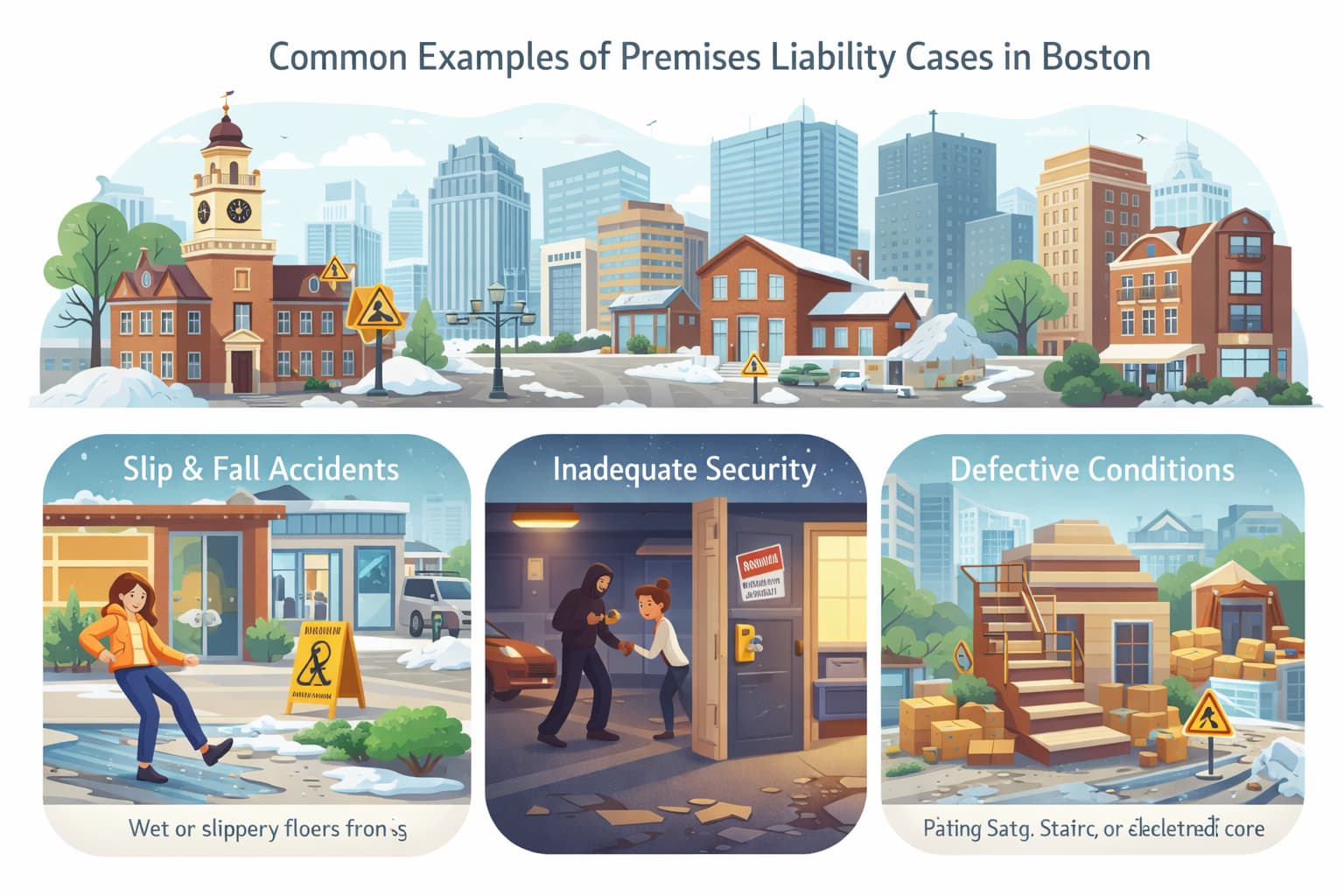
In a busy city like Boston, premises liability incidents can happen anywhere, from historic buildings to modern shopping centers. Certain types of cases are particularly common in our area.
Slip and Fall Accidents
Slip and fall or trip and fall accidents are the most frequent type of premises liability claim. These can be caused by:
- Wet or slippery floors from spills, tracked-in rain, or freshly mopped surfaces without warning signs.
- Icy or snowy sidewalks and parking lots. Massachusetts property owners have a duty to remove snow and ice in a timely manner to keep their property safe. According to Massachusetts law, owners must take reasonable steps to address these winter hazards.
- Uneven or cracked pavement, loose floorboards, or torn carpeting.
These hazards can be found in grocery stores, office buildings, and on public and private walkways throughout the city.
Inadequate Security
Property owners in certain situations have a responsibility to provide reasonable security measures to protect people from foreseeable criminal acts. A claim for inadequate security might arise if someone is assaulted or robbed in a place where the owner failed to provide basic safety features. Examples include:
- Poorly lit parking garages or stairwells.
- Broken locks on doors or gates in an apartment complex.
- Absence of security personnel in a location with a known history of crime.
These cases argue that the owner’s failure to provide adequate security contributed to the crime occurring.
Defective Conditions
Injuries are often caused by poorly maintained or defective property conditions. This can include a wide range of issues, such as:
- Broken Stairs or Handrails: A common danger in older buildings in neighborhoods like Charlestown or the North End.
- Falling Objects: Items falling from shelves in a retail store or debris from a construction site in a developing area like the Seaport District.
- Building Code Violations: Failing to meet safety standards set by local and state regulations can serve as strong evidence of negligence.
According to the National Safety Council, falls are one of the leading causes of unintentional injury-related death, highlighting how serious these incidents can be.
What to Do After Being Injured on Someone’s Property
Once you have left the scene of the accident and received initial medical attention, there are a few important steps to take to protect your well-being and any potential legal claim.
- Report the Incident in Writing: If you didn’t file a report at the scene, do so as soon as possible. Send a formal letter or email to the property owner or manager describing the date, time, and circumstances of the incident.
- Continue Your Medical Treatment: Follow your doctor’s orders, attend all follow-up appointments, and complete any physical therapy. This not only helps your recovery but also creates a clear medical record of your injuries.
- Keep Detailed Records: Start a file to keep track of everything related to the accident. Include medical bills, receipts for out-of-pocket expenses, and notes about how the injury is affecting your daily life.
- Avoid Giving a Recorded Statement: An insurance adjuster from the property owner’s company will likely contact you. It is often advisable to decline giving a recorded statement until you have had the chance to discuss your situation with a legal representative.
- Preserve Key Items: Store the shoes and clothing you were wearing at the time of the incident in a safe place. Do not wash them. They may be useful as evidence.
Taking these organized steps can make a significant difference in documenting the full impact of your injury.
How to Prove Premises Liability FAQs
Here are answers to some common questions people have about proving premises liability claims in Massachusetts.
What if I was partially at fault for my accident?
Massachusetts follows a “modified comparative negligence” rule. This means you can still recover damages as long as you are found to be 50% or less at fault for the accident. However, your total compensation will be reduced by your percentage of fault. For example, if you were found 10% at fault, your award would be reduced by 10%.
What if I was injured on public property, like a park or a T station?
Claims against government entities in Massachusetts are more complex and have stricter rules. Under the Massachusetts Tort Claims Act, you must provide written notice of your claim to the proper government agency within two years of the injury. Failing to meet this and other specific requirements can bar your claim.
What if the property owner fixed the dangerous condition right after I got hurt?
Evidence that a property owner fixed a hazard after an accident is known as a “subsequent remedial measure.” While this evidence often cannot be used to prove the owner was negligent, it can sometimes be used for other purposes, such as proving that the owner had control over the property or that a safer condition was feasible.
Contact a Boston Premises Liability Attorney
Proving a premises liability claim requires careful investigation, detailed evidence collection, and a full understanding of Massachusetts law. If you or a loved one has been injured on someone else’s property, you do not have to handle the challenges alone. An attorney can help you understand your rights and work to hold the responsible parties accountable.
At Brooks Law Firm, we are committed to helping injured individuals seek the justice and compensation they need to move forward. Our team is here to listen to your story and provide clear guidance. We offer legal support in English, Spanish, and Portuguese. Contact us today at (617) 245-8090 or through our online form for a free consultation to discuss your case.


