

Why USCIS Is Scrutinizing Marriage-Based Green Cards in 2026
Couples pursuing a marriage based green card in 2026 are walking into a very different process than the one that existed even a year ago. USCIS has tightened how it reviews family-based petitions, resumed scheduling in-person interviews for effectively all marriage-based cases, and directed officers to apply closer scrutiny to the bona fide marriage evidence that holds a case together. If you are preparing I-485 interview questions with your spouse, assembling your petition, or simply trying to understand what the changes mean, you are not alone, and the right preparation can make a real difference.
An experienced immigration lawyer can help you understand what USCIS is looking for now and build the strongest possible case. Call Brooks Law Firm today at (617) 245-8090 for a free, confidential consultation in English, Spanish, or Portuguese.
USCIS Is Strictly Scrutinizing Marriage Based Green Card Applications
The shift did not happen overnight. Over the past year, USCIS has been issuing internal guidance directing officers to conduct more rigorous checks on family-based petitions, examine marriage evidence more thoroughly, and re-interview applicants when initial answers raise questions. Reports from immigration practitioners across the country confirm that officers are spending more time on each case, requesting additional documentation at higher rates, and flagging cases for fraud investigation with less hesitation than in prior years.
Several factors are driving the change. The government has publicly stated that heightened scrutiny is part of a broader effort to combat fraudulent applications and ensure that every approved petition reflects a genuine relationship. That effort includes cross-referencing petitions when a U.S. citizen sponsor has filed for multiple relatives, reviewing social media activity, and in some cases coordinating with ICE during the interview process. There have been practitioner reports of applicants being detained at green card interviews when officers identify potential immigration violations, such as visa overstays.
For couples with legitimate marriages, none of this means the process is impossible. It does mean the margin for incomplete or disorganized filings has narrowed considerably, and the strength of your evidence package matters more than it ever has.
Related Article: How Do I Prove a Bona Fide Marriage for Immigration?
What Changed with the May 2026 USCIS Policy Memo
The most significant policy development came on May 21, 2026, when USCIS issued Policy Memorandum PM-602-0199, titled “Adjustment of Status is a Matter of Discretion and Administrative Grace.” The memo instructs officers to treat adjustment of status, the process of applying for a green card from inside the United States by filing Form I-485, as a discretionary and extraordinary form of relief rather than a routine administrative step.
This is a meaningful shift in how officers approach cases. Before the memo, adjustment of status was widely treated as the standard path for eligible applicants already living in the U.S. Under PM-602-0199, USCIS now frames it as something that should be granted only when favorable factors outweigh adverse ones, on a case-by-case basis. A USCIS spokesperson stated that someone in the U.S. temporarily who wants a green card should return to their home country to apply, except in extraordinary circumstances.
For marriage-based filers specifically, the memo’s adverse-factor framework can have serious consequences. Factors such as prior overstays, unauthorized employment, or previous immigration violations all weigh against an applicant, even when marriage to a U.S. citizen provides a legal basis for adjustment. The memo does not eliminate marriage-based adjustment of status, and it does not change the statutory eligibility requirements under INA §245. But it raises the bar for approval and gives officers wider discretion to deny cases they might previously have approved.
Green Card Through Marriage: How the Process Works
Understanding the basic framework helps you see where the new scrutiny applies. A green card through marriage involves two core steps, and USCIS can apply heightened review at both.
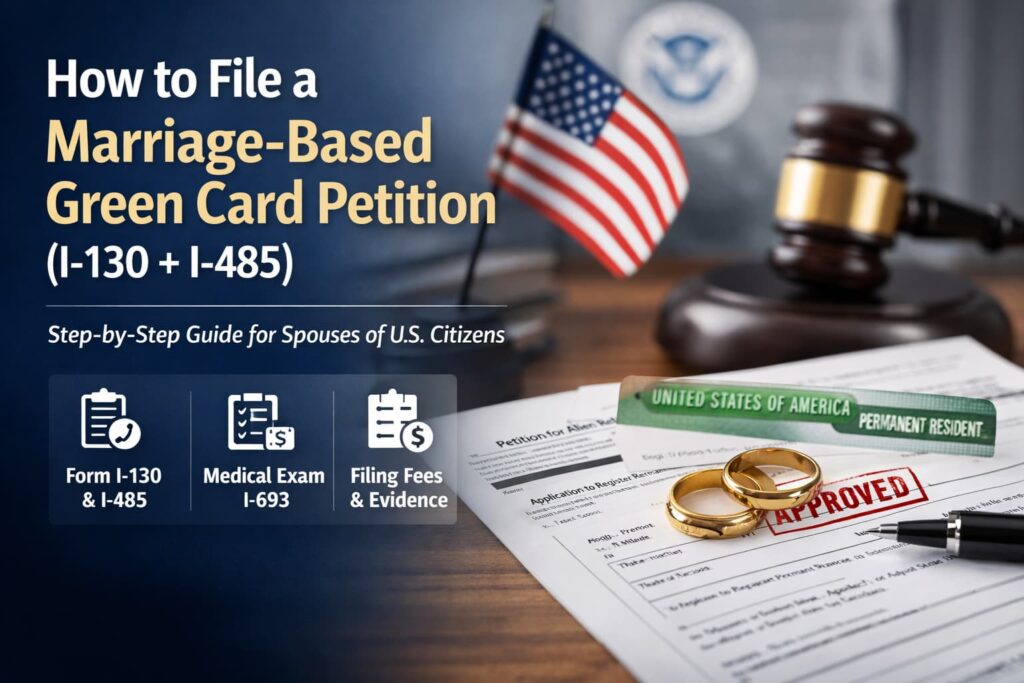
Step 1: The I-130 Petition. The U.S. citizen or lawful permanent resident (LPR) spouse files Form I-130, Petition for Alien Relative, with USCIS. This form establishes one thing: that a valid family relationship exists and that the marriage is legally valid, meaning it was not entered into primarily for immigration benefits. The I-130 does not decide green card eligibility on its own. Factors like removal proceedings, being out of status, or criminal history generally do not affect the I-130, though they matter later.
Step 2: Adjustment of Status or Consular Processing. Once the I-130 is approved (or concurrently, for immediate relatives of U.S. citizens), the foreign-born spouse applies for the green card itself. If they are in the United States, they file Form I-485 to adjust status. If they are abroad, they go through consular processing at a U.S. embassy or consulate. Under PM-602-0199, USCIS officers now weigh a broader set of favorable and adverse factors when deciding whether to grant the I-485.
If the couple has been married for less than two years when the green card is approved, USCIS issues a conditional green card valid for two years. The couple must then file Form I-751, Petition to Remove Conditions on Residence, during the 90-day window immediately before the card expires. Missing this deadline can result in termination of conditional resident status and placement in removal proceedings. When USCIS receives a properly filed I-751, it issues a receipt notice (Form I-797C) that automatically extends the conditional permanent resident’s lawful status for 48 months while the petition is processed.
Related Article: I-485 Marriage Green Card Interview Questions
What USCIS Looks at During a Marriage-Based Green Card Interview
In 2026, USCIS is scheduling in-person interviews for effectively all marriage-based green card applicants. While the regulation technically allows USCIS to waive the interview on a case-by-case basis, a waiver is a discretionary exception rather than something any applicant should expect. Both spouses must appear at the local USCIS field office (in Massachusetts, that is the Boston or Lawrence office).
Officers place both spouses under oath and ask detailed questions designed to reveal whether the couple genuinely shares a life. Common areas of questioning include:
- How and when the couple met, and the timeline from dating to engagement to marriage
- Daily routines, including who cooks, who does school pickup, and how the household runs
- Specifics about the home, such as how many bedrooms, which side of the bed each person sleeps on, and recent purchases or changes
- Each other’s family members, birthdays, and employment
- Whether the applicant knew about the spouse’s immigration status before marrying
Officers in 2026 are also paying closer attention to social media history, consistency between prior visa applications and current statements, and any periods of unlawful presence. If the officer has concerns after the joint interview, the couple may be separated for a Stokes interview, where each spouse is asked the same detailed questions individually and the answers are compared.
The best preparation is not memorization. Officers can tell when someone is reciting a script, and the stress of performing makes mistakes more likely. The better approach is alignment: discuss key dates and definitions with your spouse beforehand, so that you are both referring to the same events. Does “the wedding” mean the city hall ceremony or the family celebration?
Does “how we met” mean the app or the first in-person date? Ballpark answers are acceptable for most things, and “I don’t know” is better than guessing, except for birthdays and your anniversary. Interpreters are always appropriate if you are more comfortable speaking in another language.
What Counts as a Bona Fide Marriage for USCIS
At its core, USCIS wants to see that your marriage is real, that you entered it in good faith, and that you share a genuine life together. A bona fide marriage means one entered into with the genuine intention of building a shared life, not one arranged primarily to obtain an immigration benefit.
The evidence that matters most falls into three categories:
- Shared finances. Joint bank accounts with regular activity, joint tax returns filed as married, shared credit cards, insurance policies listing each other as beneficiaries, and joint loans or a mortgage.
- Shared residence. A lease or deed in both names, utility bills at the same address, driver’s licenses showing the same address, and official mail addressed to both spouses.
- Relationship history. Photographs across time and settings (two seasons of photos together are stronger than thirty wedding-day shots), sworn affidavits from people who know the couple in different contexts, travel records, and communication history for couples who were long-distance.
Quality outweighs quantity in every category. A joint bank account opened the day before filing tells USCIS nothing. A joint card used for groceries and gas over three years tells a real story. Three genuine, detailed affidavit letters from people who know you in different contexts are stronger than fifty template letters.
When standard evidence does not exist, explain why and substitute. Young couples or newly formed households may not yet have years of shared financial records, and that is not inherently suspicious if the rest of the package tells the story of how the couple actually lives.
Red Flags That Trigger Closer USCIS Review
Certain patterns cause officers to look more carefully at a case. None of these factors is an automatic denial, but each one means your evidence needs to be stronger:
- Marriage shortly after the foreign-born spouse entered the U.S. on a temporary visa (B-2 to marriage-based adjustment, F-1 to marriage-based adjustment, J-1 to marriage-based adjustment are the most common patterns)
- A significant age difference between spouses
- A language barrier that limits communication
- The couple living separately without a well-documented explanation
- The U.S. citizen spouse having filed previous immigration petitions for other spouses
- A Notice to Appear (NTA) issued before the marriage, which raises a presumption under immigration law that the marriage was entered for immigration benefits
- Inconsistencies between the application and interview answers
If any of these factors apply to your situation, the solution is not to hide them. It is to address them head-on with a clear explanation and supporting evidence. An applicant who entered on a student visa and married a U.S. citizen six months later has a perfectly viable case if the relationship is genuine and well documented. The key is anticipating what the officer will question and building the record accordingly.
Related Article: Legal Protections for Immigrants Facing Threats of Deportation
Immigration Lawyer for Marriage Based Green Card: Why Representation Matters Now
The 2026 environment has made professional guidance more valuable than it has been in years. With USCIS applying broader discretion under PM-602-0199, in-person interviews scheduled in effectively all cases, and a policy framework that treats adjustment of status as extraordinary relief, the difference between a well-prepared case and an incomplete one can determine the outcome.
An experienced immigration attorney helps in several concrete ways:
- Building the evidence package. An attorney knows what USCIS officers are trained to look for and can identify gaps in your documentation before USCIS does. If you and your spouse are young and do not yet have years of shared financial history, an attorney can guide you on alternative evidence that tells your story.
- Interview preparation. Practicing with an attorney who understands how officers question couples can reduce anxiety and prevent the kind of nervous inconsistencies that trigger follow-up investigation. This is especially important for couples who may face a Stokes interview.
- Responding to RFEs and NOIDs. If USCIS issues a Request for Evidence or a Notice of Intent to Deny, the response window is limited and the stakes are high. An attorney can craft a targeted response that directly addresses the officer’s concern.
- Navigating the I-751 process. Removing conditions on a conditional green card requires filing within a strict 90-day window and providing updated evidence of the ongoing marriage. If you have separated or divorced, or if you experienced abuse, an I-751 waiver petition may be filed at any time, but the requirements are specific and an attorney’s guidance may be essential.
- Addressing adverse factors under the new memo. If your case involves any prior immigration violations, overstays, or other adverse factors that PM-602-0199 instructs officers to weigh, an attorney can help you present favorable factors that support a positive exercise of discretion.
Related Article: Final Removal Order: Legal Options That May Still Be Available to You
What You Should Do Right Now
If you are in the process of filing a marriage-based green card petition, or if you have a pending case and have not yet been interviewed, the single most important step is treating the evidence package as the foundation of your case. Gather documentation across all three categories (finances, residence, and relationship history), organize it clearly, and fill any gaps now rather than after USCIS sends a Request for Evidence.
If you have already received a conditional green card, mark the I-751 filing window on your calendar and begin collecting updated evidence of your continuing marriage well before the 90-day window opens.
And if anything about your case feels uncertain, whether that is a prior overstay, a previous immigration filing, or simply not knowing what USCIS expects in 2026, do not wait. Reach out to Brooks Law Firm today at (617) 245-8090 to schedule a free consultation. Our team will give you an honest look at where your case stands and what you can do to strengthen it. We serve clients across Massachusetts and beyond in English, Spanish, and Portuguese.


