


What Are the Steps in a Personal Injury Lawsuit?
A personal injury lawsuit is a formal process that allows a person who has been harmed to seek financial compensation from the party responsible for their injuries. The steps in a personal injury lawsuit are designed to be thorough and fair, moving from an initial investigation all the way to a potential trial, though most cases are resolved before reaching a courtroom. Understanding this journey can help you feel more prepared and in control as you focus on your recovery.
Contact a personal injury lawyer today to understand your options and take the next step toward fair compensation.
Key Takeaways about the Steps in a Personal Injury Lawsuit
- A personal injury lawsuit is a structured legal journey with several distinct phases, starting long before a case is filed in court.
- The initial steps involve consulting with an attorney, who will then conduct a detailed investigation into the accident and the resulting damages.
- A critical phase called “discovery” allows both sides to formally exchange evidence and information, which is essential for building a case.
- The vast majority of personal injury cases are resolved through settlement negotiations, often with the help of a neutral mediator.
- While going to trial is possible, it is the final step in the process and occurs only when a fair settlement cannot be reached.
The First Step: Consulting with a Personal Injury Attorney

The very first action to take after an injury is to focus on your health. Once you are able to think about the future, one of the most productive initial steps in a personal injury lawsuit is speaking with an attorney. This initial meeting, often called a consultation, is typically free and gives you a chance to share your story and understand your potential legal options without any obligation.
During this conversation, the attorney will ask about the details of your accident, the extent of your injuries, and the impact this has had on your life. They will want to review any documents you have. Bringing certain items can make this first meeting very productive.
- Any police reports or incident reports that were created.
- Photos or videos you took of the accident scene, your injuries, or property damage.
- The names and contact information of any witnesses.
- All medical records, bills, and receipts related to your treatment.
- Information from your employer about missed work and lost wages.
Having these documents helps an attorney get a clearer picture of your situation and assess the strength of your potential claim.
The lawyer will explain how they are paid, which in personal injury cases is usually on a “contingency fee” basis. This means the attorney’s fee is a percentage of the financial recovery they obtain for you, and you pay nothing upfront or if the case is not successful. This arrangement allows everyone, regardless of their financial situation, to access legal representation.
Phase One: Pre-Litigation Investigation and Demand
Before a lawsuit is ever filed in a courthouse, a significant amount of work happens behind the scenes. This is the pre-litigation phase, where your attorney builds the foundation of your case. They will conduct a full investigation, which can involve visiting the accident scene, interviewing witnesses, gathering all your medical records, and hiring investigators or other professionals if needed.
A key part of this phase is calculating your “damages.” This is a legal term for the total losses you have suffered because of the injury. Damages are typically broken into two main categories:
- Economic Damages: These are the losses with a clear monetary value, like medical bills, future medical care costs, lost income from being unable to work, and damage to property.
- Non-Economic Damages: These are losses that don’t have a specific price tag but are just as real. They include pain and suffering, emotional distress, and loss of enjoyment of life.
Once your attorney has a full understanding of your damages and has collected strong evidence showing the other party was at fault, they will typically send a “demand letter” to that party’s insurance company. This letter outlines the facts of the case, presents the evidence of fault, details your injuries and damages, and demands a specific amount of money to settle the claim. This often starts a period of negotiation.
Phase Two: Filing the Lawsuit and Initial Pleadings
If the insurance company denies the claim or refuses to offer a fair settlement, the next step is to begin the formal lawsuit process. This is known as litigation. It begins when your attorney files a legal document called a “Complaint” with the appropriate Massachusetts court. For example, a serious car accident case in Boston might be filed in the Suffolk Superior Court.
The Complaint officially starts the lawsuit. It names the person you are suing (the “defendant”) and explains the legal and factual reasons why they are responsible for your injuries. After the Complaint is filed, a copy of it, along with a “Summons,” must be officially delivered to the defendant. A summons is a legal notice that informs them they are being sued and have a specific amount of time to respond.
The defendant, through their attorney, will then file a response document called an “Answer.” In the Answer, they will respond to each allegation made in your Complaint, either admitting to them, denying them, or stating they don’t have enough information to respond. Once the Answer is filed, the case moves into the next major phase.
Phase Three: The Discovery Process
Discovery is often the longest part of a personal injury lawsuit. It is the formal process where both sides exchange information and evidence related to the case. The goal of discovery is to make sure all parties have access to all the relevant facts so there are no surprises if the case eventually goes to trial. The Massachusetts Rules of Civil Procedure govern this entire process.
Several tools are used during discovery to gather information:
- Interrogatories: These are written questions that one party sends to the other, which must be answered in writing and under oath.
- Requests for Production of Documents: This is a formal request for the other party to provide copies of relevant documents, such as maintenance records for a truck involved in a crash or a driver’s logbook.
- Depositions: This is out-of-court testimony given under oath. Attorneys for both sides are present, and the person being deposed answers questions. A court reporter records everything that is said.
- Requests for Admissions: These are written statements that one party asks the other to either admit or deny. This helps narrow down the issues that are actually in dispute.
The information gathered during the discovery process is vital for building your case and is often what convinces an insurance company to offer a fair settlement.
Phase Four: Motions, Mediation, and Negotiation
As discovery proceeds, the attorneys may file “motions” with the court. A motion is a request for the judge to make a decision on a particular issue. For instance, an attorney might file a motion to exclude certain evidence from being used at trial.
During this time, settlement negotiations often continue. As more evidence is revealed through discovery, both sides get a better sense of the strengths and weaknesses of their case. This can lead to more productive settlement talks. Many courts in Massachusetts will also require the parties to attend mediation.
Mediation is a process where a neutral third party, called a mediator, helps the two sides try to reach a mutually agreeable settlement. The mediator doesn’t make any decisions but instead facilitates the conversation and helps find common ground. It is a confidential and non-binding process, meaning you are not forced to accept a settlement if you don’t want to. This is often one of the most important steps in a personal injury lawsuit for resolving a case without a trial.
Only a very small percentage of personal injury cases ever go to a full trial. The great majority are resolved through a settlement agreement reached during these negotiation or mediation phases.
Phase Five: The Trial
If all attempts to settle the case fail, the final step is to go to trial. A personal injury trial is a formal proceeding where both sides present their evidence and arguments to a judge and, most often, a jury. The jury’s job is to listen to the evidence and decide if the defendant is legally responsible for the plaintiff’s injuries and, if so, how much compensation should be awarded.
A trial has several distinct parts:
- Jury Selection: The attorneys for both sides question potential jurors to select a fair and impartial panel.
- Opening Statements: Each attorney gives an overview of the case and what they intend to prove.
- Presentation of Evidence: The plaintiff’s attorney goes first, calling witnesses to testify and presenting evidence. The defendant’s attorney has the opportunity to cross-examine those witnesses. Then, the defendant’s attorney presents their case.
- Closing Arguments: Each attorney summarizes their case and argues why the jury should rule in their favor.
- Jury Deliberation and Verdict: The judge gives the jury legal instructions, and the jury then goes to a private room to discuss the case and reach a decision, which is called the verdict.
The trial is the culmination of all the previous work and is the final opportunity to have your story heard and decided by a group of your peers.
What Happens After a Verdict? Post-Trial Motions and Appeals
Even after a jury reaches a verdict, the legal process may not be completely over. The losing party might file post-trial motions, asking the judge to set aside the jury’s verdict or order a new trial for various legal reasons.
Additionally, the party that lost at trial has the right to file an “appeal.” An appeal is a request for a higher court to review the proceedings of the trial court to check for any legal errors that might have affected the outcome. The appeals process can add a significant amount of time to the final resolution of a case. It involves written legal arguments and sometimes oral arguments before a panel of appellate judges.
How Long Do the Steps in a Personal Injury Lawsuit Take?
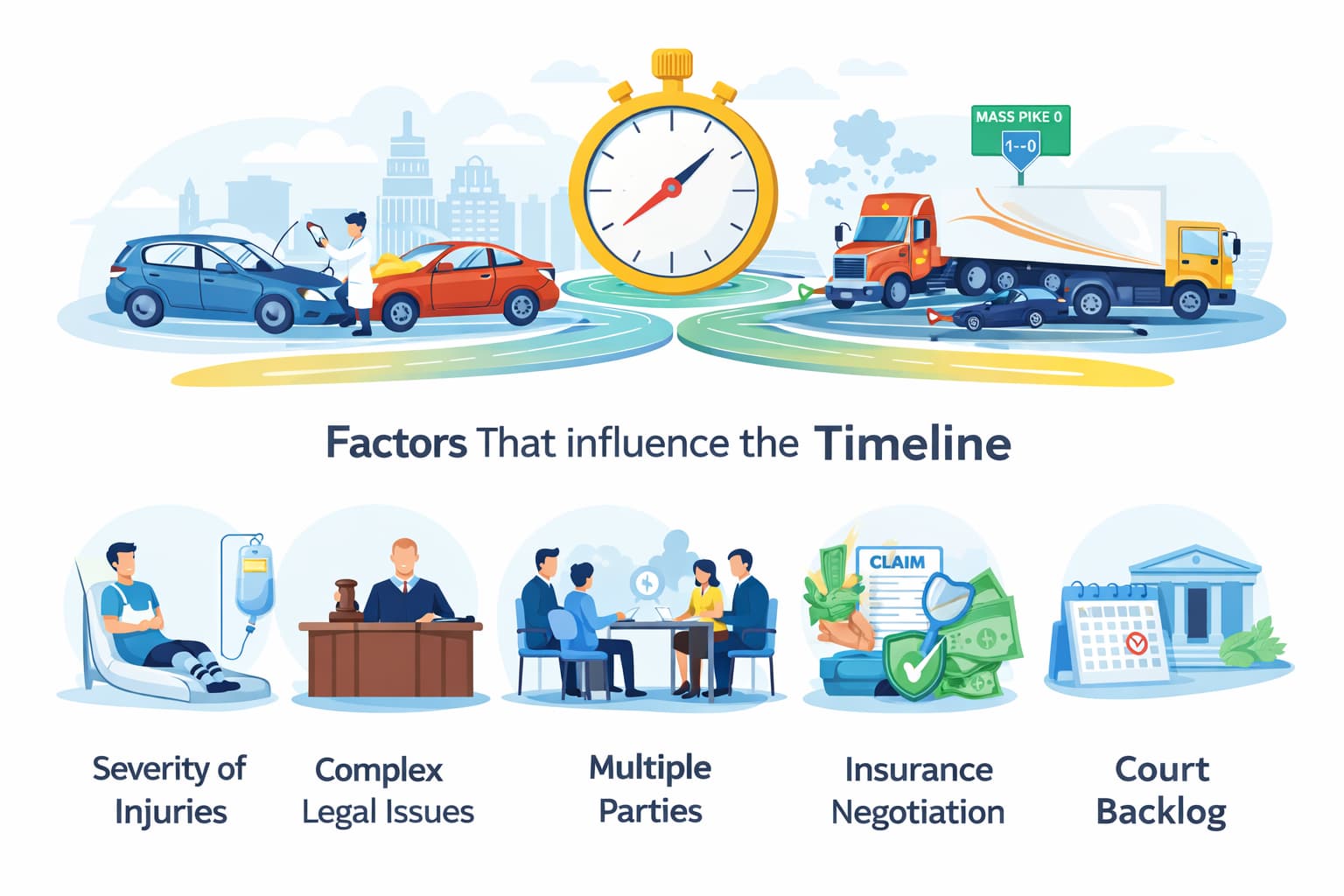
One of the most common questions people have is about the timeline. There is no simple answer, as the duration depends on many factors. A straightforward case involving a car accident on a local Boston street with clear fault and minor injuries might settle in a matter of months. However, a complex case involving a truck accident on the Mass Pike with catastrophic injuries could take several years to resolve.
Factors that influence the timeline include:
- The severity of your injuries and the length of your medical treatment.
- The complexity of the legal and factual issues in the case.
- The number of parties involved.
- The willingness of the insurance company to negotiate fairly.
- The schedule and backlog of the local Massachusetts court system.
An experienced attorney can provide a general idea of a potential timeline based on the specifics of your case, but it’s important to understand that the process is designed to be thorough, which often takes time.
Personal Injury Lawsuit Process FAQs
Here are answers to some other common questions about the legal process.
What is the statute of limitations for a personal injury claim in Massachusetts?
In Massachusetts, the “statute of limitations,” which is the deadline for filing a lawsuit, is generally three years from the date of the injury. If you do not file your lawsuit within this time frame, you will likely lose your right to seek compensation. There are some exceptions, so discussing your specific situation with an attorney is important.
What if I was partially at fault for my accident?
Massachusetts follows a “modified comparative negligence” rule. This means you can still recover damages as long as your percentage of fault is not more than 50%. Your total compensation will be reduced by your percentage of fault. For example, if you are found to be 10% at fault, your award would be reduced by 10%.
What is the difference between a settlement and a verdict?
A settlement is a voluntary agreement reached between the parties to resolve the case, usually for an agreed-upon amount of money. It can happen at any time before a verdict is reached. A verdict is the formal decision made by a jury (or a judge in some cases) after a full trial.
Can I still file a lawsuit if I am not a U.S. citizen?
Yes. Your immigration status does not affect your right to file a personal injury lawsuit and seek justice through the U.S. court system. The law protects all individuals who are injured due to someone else’s negligence, regardless of where they were born or their citizenship status.
Connect with a Personal Injury Attorney in Boston
If you have been injured in an accident, understanding your rights and the steps in a personal injury lawsuit is the first move toward protecting your future. At Brooks Law Firm, we are committed to providing clear guidance and strong advocacy for every client.
We understand the unique challenges faced by families in our community, including our vibrant immigrant population. Our team provides legal support in English, Spanish, and Portuguese, and we ensure you can always communicate directly with your attorney. We are dedicated to fighting for the full and fair compensation you need to cover your medical bills, lost wages, and other losses.
Contact Brooks Law Firm today at (617) 245-8090 or through our online form for a free, no-obligation consultation to discuss your case.


