

Federal Judge Strikes Down 75-Country Immigrant Visa Ban
If you or a family member has been waiting for an immigrant visa from one of the 75 countries affected by the Trump administration’s 75-country immigrant visa ban, a federal court just removed a major obstacle from your path. Call Brooks Law Firm today at (617) 245-8090 for a free consultation with an experienced immigration lawyer to find out how this ruling affects your case.
On August 21, 2026, U.S. District Judge Jeannette A. Vargas of the Southern District of New York ruled in CLINIC v. Rubio that the State Department’s policy suspending immigrant visa issuance to nationals of 75 countries was unlawful. The court vacated the policy in its entirety and set aside any visa refusals that were based solely on the ban.
What the 75-Country Visa Ban Was and Why It Mattered
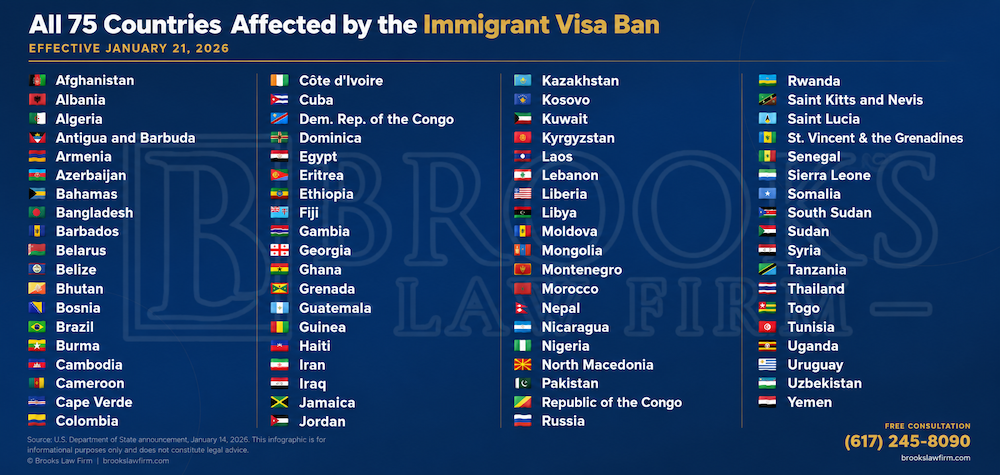
In January 2026, the State Department announced that it would indefinitely suspend the issuance of immigrant visas to nationals of 75 countries, including Brazil, Colombia, Haiti, Egypt, Iran, Russia, Somalia, and Yemen. The list covered nearly 40% of the world’s countries, and the administration said the suspension was intended to prevent the admission of immigrants who might become dependent on public benefits in the United States.
In practice, though, the policy went far beyond the existing public charge standard.
Under federal immigration law, consular officers can deny an immigrant visa if they determine that a specific applicant is likely to become a public charge, but that decision requires an individualized review of the person’s age, health, financial resources, education, and skills.
The 75-country policy instructed consular officers not to issue immigrant visas to nationals of the affected countries even when an applicant could demonstrate that they were unlikely to become a public charge.
The ban applied to immigrant visas, the kind that lead to permanent residence through family-based or employment-based sponsorship. It did not apply to nonimmigrant visas such as tourist and student visas, and it did not affect adjustment of status filings for people already inside the United States.
For the thousands of families and workers whose cases were frozen at U.S. consulates abroad, the result was months of separation and uncertainty with no clear end date.
What Judge Vargas Decided
Judge Vargas found that the State Department could not replace individualized visa decisions with a blanket restriction based on nationality. In a 61-page decision, she ruled that the policy violated the Immigration and Nationality Act in multiple ways.
First, federal immigration law explicitly prohibits consular officers from basing their decisions in the visa review process on nationality. The 75-country policy did exactly that, categorically refusing applicants because of the country on their passport rather than anything about their individual circumstances.
Second, immigration law gives consular officers, not the Secretary of State, the authority to make individualized visa decisions. Judge Vargas found that the policy represented a direct override of this statutory framework by stripping consular officers of the discretion Congress gave them and ordering them to refuse eligible applicants.
The administration had pointed to the Supreme Court’s 2018 decision upholding a version of President Trump’s first-term travel ban. But Vargas distinguished that case, finding that the earlier dispute concerned presidential authority over who may enter the United States, while the current case involved the separate question of whether the State Department could prohibit consular officers from issuing visas to otherwise eligible applicants.
In the end, the court concluded that in practice, U.S. officers were ordered to reject visas for applicants, even those who could support themselves, solely based on the country they came from.
What This Ruling Changes
The ruling vacates the State Department policy, meaning the 75-country suspension can no longer serve as the basis for refusing an immigrant visa. It also sets aside previous visa refusals that were based solely on the ban, potentially allowing those cases to return to consular officers for consideration under normal immigration rules.
That does not mean every applicant who was previously denied will now be automatically approved. Applicants may still face other legal requirements, background checks, inadmissibility grounds, or case-specific concerns. The public charge standard itself remains part of immigration law, and what changes is that consular officers must go back to evaluating each applicant as an individual rather than refusing them based on nationality alone.
It is also important to understand that this ruling does not affect Presidential Proclamation 10998, a separate measure that suspends entry for nationals of 39 countries, which took effect on January 1, 2026, and remains in force.
As of August 24, 2026, no stay or government appeal has been publicly confirmed. The government can still appeal the ruling to the Second Circuit Court of Appeals, and the parties have until September 11, 2026, to submit proposals addressing remaining claims in the case. The State Department also has not issued updated guidance on how consular posts should actually resume processing, which means there may be a real lag between the court order and what happens at any specific embassy or consulate.
What This Means for Immigrants in Massachusetts
The CLINIC v. Rubio ruling is a significant development, but it is not the only legal challenge to this ban.
Brooks Law Firm has been fighting this policy in federal court since it took effect, and the firm has already achieved results for its clients. Earlier this year, Brooks Law Firm secured a preliminary injunction in Ullah v. LaFave and Rubio in the United States District Court for the District of Massachusetts, where U.S. District Judge Leo T. Sorokin found that the plaintiffs are likely to succeed on the merits and ordered the government to lift the pause as applied to the firm’s client’s case. Brooks Law Firm is one of only two firms in the country to secure that kind of relief.
The firm is also actively enrolling plaintiffs for a mass action challenging the ban in federal court. If your immigrant visa has been denied, delayed, or placed on hold because of the 75-country policy, you may be eligible to join as an individual plaintiff.
The enrollment deadline is August 30, 2026, so time to act is limited.
What Brazilian Applicants Should Know
Brazil was among the 75 countries subject to the ban, and for the Brazilian community in Massachusetts, one of the largest in the country, this policy created enormous hardship.
According to U.S. government data, Brazil ranked 10th among sources of new U.S. permanent residents in 2023, with over 28,000 approvals, and that pipeline was effectively shut down in January when the ban took effect.
The ruling in CLINIC v. Rubio means that Brazilian nationals whose immigrant visa cases were frozen or refused solely because of the 75-country policy may now have their cases reconsidered by consular officers under the normal rules.
Family-based petitions filed by U.S. citizen spouses, parents, or siblings of Brazilian nationals, and employment-based cases for Brazilian workers, are once again eligible for processing at consulates in São Paulo, Rio de Janeiro, and Brasília.
There are a few important distinctions for Brazilian applicants to understand.
The ban only affected immigrant visas processed through U.S. consulates abroad. Brazilian nationals who are lawfully present in the United States may still be eligible to apply for permanent residence through adjustment of status, a process that was never suspended by this policy.
For Brazilians who were already in the U.S. on a valid visa, adjustment of status may have been, and may continue to be, a viable alternative to consular processing, depending on their eligibility. An immigration attorney can help you evaluate which pathway makes the most sense for your situation.
Additionally, nonimmigrant visa categories like tourist visas, student visas, H-1B, L-1, O-1, and other work visas were never affected by the 75-country ban. The ruling specifically addresses the immigrant visa freeze. Because the government has not yet issued guidance on how consulates will resume processing, Brazilian applicants should not assume their cases will move immediately, but this is the moment to review your case with an attorney, make sure your documentation is current, and be ready to act when consulates begin scheduling interviews again.
What Affected Immigrants in Massachusetts Can Do Now
Whether you are Brazilian, Haitian, Colombian, or from any of the other 75 countries on the list, the ruling opens a window that has been closed for seven months. The situation is still evolving, and acting strategically matters more than acting fast.
If your immigrant visa was refused or frozen because of the ban, hold onto any denial notice that mentions the policy. These refusals may now be eligible for reconsideration under the court’s order. If you have a pending family-based or employment-based petition, confirm that your supporting documents, including medical exams, financial affidavits, and civil documents, are up to date and have not expired during the freeze.
If you are already in the United States on a valid visa and may be eligible to adjust status rather than process through a consulate abroad, this is the time to explore that option with an immigration attorney. The adjustment of status pathway was never suspended and may offer a more predictable timeline depending on your circumstances.
If your case involves one of the 39 countries also covered by Presidential Proclamation 10998, be aware that the separate travel ban remains in effect and was not part of this lawsuit. An attorney can help you understand whether and how both policies apply to your situation.
For a detailed breakdown of the ban, who it affects, what the lawsuit involves, and how to enroll in the mass action before the August 30 deadline, visit the Brooks Law Firm 75-Country Immigrant Visa Ban Lawyer page.
Talk to Someone Who Understands
If you were affected by the 75-country immigrant visa ban, this ruling may change what is possible for your case, but only if you take the right steps at the right time. Brooks Law Firm was built by immigrants, for immigrants, and our team understands what this moment means because many of us have lived it ourselves.
We offer consultations and legal services in English, Spanish, and Portuguese so you can speak with an attorney in your own language about what comes next. Reach out to Brooks Law Firm today at (617) 245-8090 to schedule a free consultation, and we will give you an honest look at where your case stands.


