


Nationwide I-485 Interview Questions for Marriage Green Cards: What to Expect & How to Prepare
The I-485 marriage interview is the final verification step in your green card journey. A U.S. Citizenship and Immigration Services (USCIS) officer has one primary goal: to assess whether your marriage is bona fide (real) and not entered into for the sole purpose of obtaining an immigration benefit.
The officer also confirms whether the applicant is admissible, meaning you are legally permitted to become a permanent resident. The stakes are high; a denial could lead to removal proceedings. However, with honest and thorough preparation, this interview is simply an opportunity to confirm the facts you have already provided.
Most couples with genuine relationships successfully complete this interview. The stories of intense interrogations and immediate denials usually stem from a lack of preparation or unaddressed inadmissibility issues. Both of these are manageable, especially with proper legal guidance.
If you have a question about your upcoming interview or a complicated immigration history, speak with an experienced green card lawyer at at (617) 245-8090.
Key Takeaways for the I-485 Marriage Green Card Interview
- The interview’s primary purpose is to confirm your marriage is genuine. USCIS officers ask detailed questions about your relationship history and daily life to detect marriage fraud.
- Complete honesty about your entire history is required. You must disclose all past criminal incidents and immigration violations, as USCIS background checks are comprehensive and omissions are a major red flag.
- Thorough preparation is the key to a smooth process. Gathering extensive evidence of your shared life and reviewing your application forms together prevents the simple inconsistencies that raise suspicion.
The Basic Requirements of the Marriage Green Card Interview
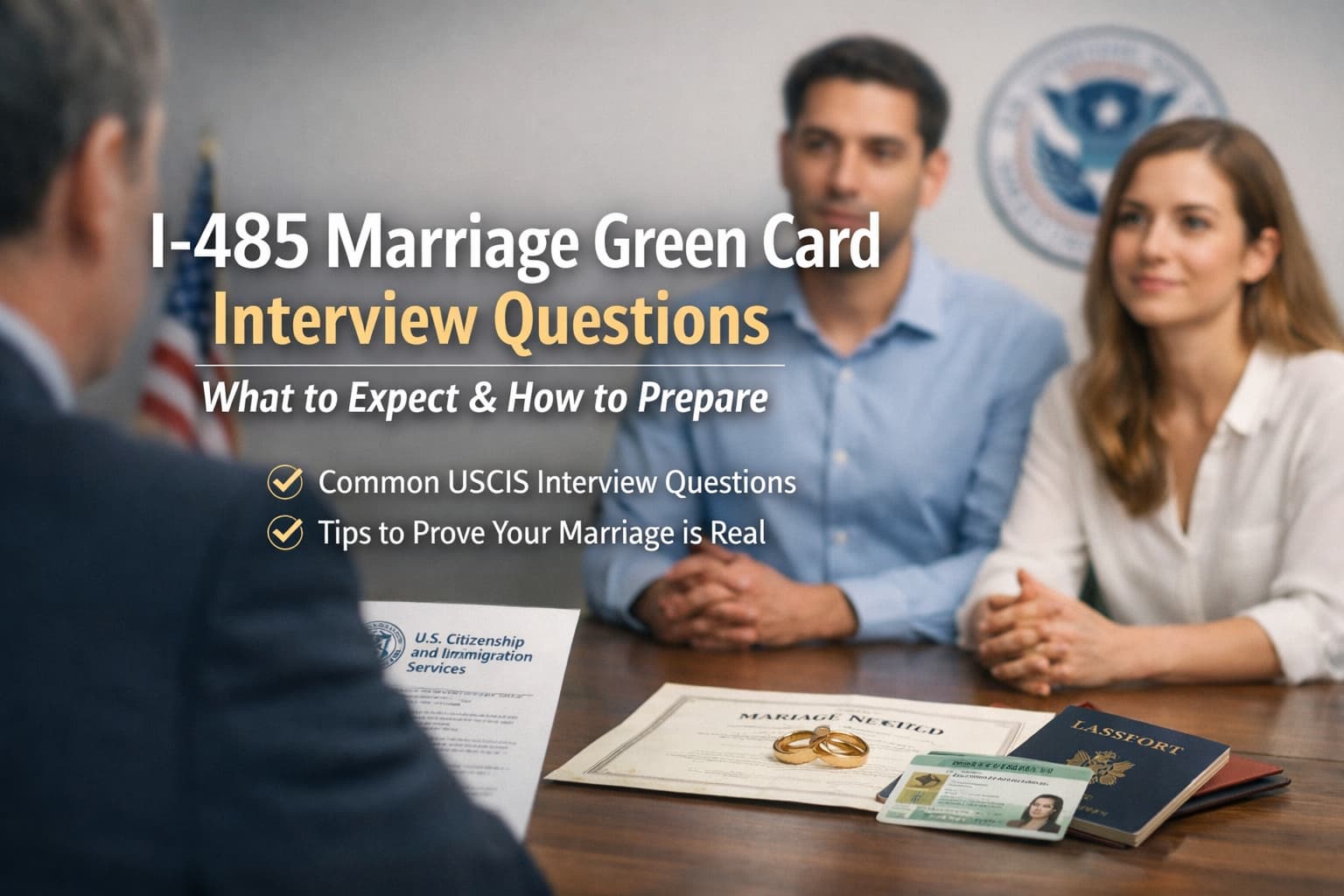
Both the petitioner (the U.S. Citizen spouse) and the beneficiary (the foreign spouse) must attend the interview together. If you have children who are also applying for green cards as derivatives, they may also be required to appear. This is a joint process, and the officer will observe your interaction as a couple. Your presence together is non-negotiable.
The interview takes place at the local USCIS Field Office that has jurisdiction over your place of residence. For most of our clients in Massachusetts, this is the Boston Field Office, located in the John F. Kennedy Federal Building on New Sudbury Street. USCIS scheduling varies, but most marriage-based adjustment of status cases require this in-person meeting. The officer’s objective is not merely to review paperwork but to detect potential marriage fraud, as mandated by INA §204(c), which has severe, lifelong consequences for immigrants.
What to Expect: The Standard Interview Flow
Plan to arrive at the federal building approximately 15 to 30 minutes before your scheduled time. You will pass through security, similar to an airport, before checking in at the USCIS window with your appointment notice and photo IDs. Phones are typically allowed in the waiting room, but it’s best to confirm the specific rules for your field office.
An officer will call your name and lead you to their office. The first official step is being placed under oath, where you swear to tell the truth. Lying to a federal immigration officer has serious penalties, including the denial of your case and potential criminal charges. Honesty is your only strategy. If you do not remember a specific detail, it is far better to say so than to guess.
Here’s a high-level summary of what to expect:
- The interview usually begins with simple verifications. The officer will ask to see your original documents—passports, birth certificates, and any prior divorce decrees—to compare them against the copies you submitted.
- They will then go over the basic information on your I-130 (Petition for Alien Relative) and I-485 (Application to Adjust Status) forms, confirming details like names, addresses, and employment.
- The officer will also ask for any new evidence of your shared life that you have accumulated since filing your application, such as recent joint bank statements, a new lease, or photos from a recent holiday.
Most interviews are conversational, but the tone shifts quickly if the officer detects inconsistencies or red flags.
The Bona Fide Test: Detailed Question Categories
The core of the interview is proving your marriage is legitimate. USCIS officers are trained to ask questions that are difficult to fabricate answers for. They look for consistency between your answers and the evidence you’ve provided. The questions fall into several distinct categories.
Category 1: The Relationship History (The Origin Story)
The officer needs to understand how your relationship began and evolved. They are listening for a logical and believable narrative.
Expect questions like:
- How, when, and where did you first meet?
- Who initiated the first conversation or date?
- What did you do on your first date?
- When did you consider your relationship to be exclusive?
- When did you introduce each other to your parents or close friends?
These questions are to see if the story makes sense. A story about falling in love at first sight despite having no common language or shared background might raise suspicion without a compelling explanation.
Category 2: The Wedding and Proposal
The circumstances surrounding your engagement and wedding are also important milestones that a genuine couple would remember. The officer may ask:
- Who proposed, and where and how did it happen?
- Why did you decide to get married?
- Who attended your wedding ceremony? Were your parents there?
- What did you do after the ceremony? Did you have a reception or a simple dinner?
- Were wedding rings exchanged?
A simple courthouse wedding is perfectly acceptable, but an inability to describe what you did afterward suggests the event was a transaction rather than a celebration of your commitment.
Category 3: Daily Routine and Domestic Life (The Pillow Talk Test)
These questions are designed to test your knowledge of each other’s daily habits and your shared home life.
- Who wakes up first in the morning? Is an alarm clock used?
- How does your spouse take their coffee or tea?
- What side of the bed does your spouse sleep on?
- Who is responsible for paying the household bills?
- What television shows are you watching together right now?
Category 4: Home and Surroundings
Questions about your physical living space confirm that you cohabitate and share a life. These details are easy for someone who lives in the home to recall but difficult for someone who does not.
- How many bedrooms and bathrooms are in your home?
- Can you describe the curtains or blinds in your bedroom?
- What color is your couch?
- Do you have a garage or assigned parking spot?
- Where do you keep the trash can in the kitchen?
For applicants in the Boston area, these questions might be tailored to local life. For example, an officer might ask if you take the “T” to work and which stop you use, or how you handle street parking during snow emergencies.
Admissibility & Statutory Questions (The I-485 Form)
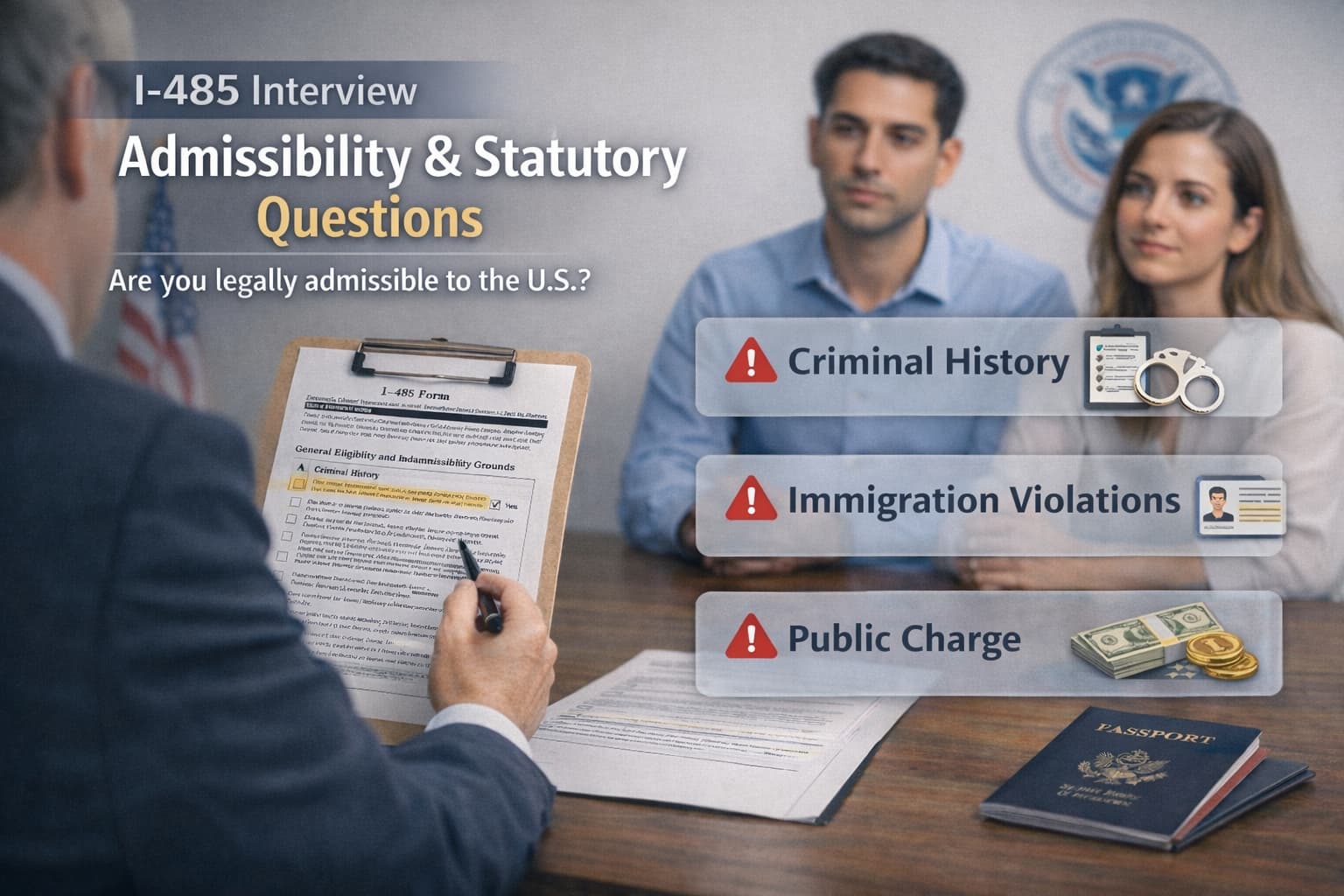
Beyond the bona fides of your marriage, the officer must confirm that the immigrant spouse is admissible to the United States. They will verbally go through the “General Eligibility and Inadmissibility Grounds” section of the I-485 form, which contains a long list of yes/no questions.
Criminal History
One of the most serious areas of inquiry is your criminal history. The form asks if you have ever been arrested, cited, charged, or convicted of any crime. You must answer this truthfully, even if the charges were dismissed, expunged, or sealed. USCIS background checks are extensive and will likely uncover any undisclosed incidents.
Certain crimes, particularly Crimes Involving Moral Turpitude (CIMTs) and controlled substance violations, may make you inadmissible. If you have any criminal record, consulting an experienced immigration attorney before your interview is not just a good idea; it’s a necessity.
Immigration Violations
Past immigration violations must also be disclosed. For spouses of U.S. citizens, an overstay of a prior visa is generally forgiven. However, more serious violations, such as making a false claim to U.S. citizenship (for example, on an I-9 employment form), results in a permanent bar from receiving a green card.
Public Charge
The officer will ask questions to ensure you are not likely to become primarily dependent on the government for subsistence. This is known as the public charge ground of inadmissibility.
The current 2022 Public Charge Final Rule clarifies that USCIS will primarily consider the receipt of cash assistance for income maintenance, like SSI or TANF, or long-term institutionalization at government expense. The use of most non-cash benefits, such as Medicaid (except for long-term care), food stamps (SNAP), or housing assistance, does not make you a public charge.
Handling Red Flags and The Stokes Interview
Certain circumstances in a relationship might cause a USCIS officer to apply extra scrutiny. These are not automatic grounds for denial, but they require you to provide stronger evidence and clearer explanations.
Common Red Flags Include:
- Significant age differences.
- A lack of a common language.
- Living in separate residences, even with a good reason (like work or school).
- A very short courtship period before marriage.
- Previous immigration petitions filed for the foreign spouse.
What Is the Stokes Interview?
If the officer has serious doubts about your marriage after the initial joint interview, they may decide to conduct a Stokes interview.
Named after a court case, this procedure involves separating you and your spouse and asking each of you the same set of highly detailed questions. The interviews are typically recorded, and the officer compares your answers for inconsistencies.
Questions become incredibly granular, such as “What color is your spouse’s toothbrush?” or “What did you each have for dinner last night?”. The best strategy is to answer honestly. If you don’t know or can’t remember something, say that. A wrong answer that conflicts with your spouse’s is far more damaging than admitting you forgot.
For couples married less than two years at the time of the interview, you will be granted Conditional Residency for two years. The officer is not only adjudicating your current application but is also taking notes for your I-751 Petition to Remove Conditions, which you will file two years later. They are looking for signs of a long-term, stable marital union.
FAQ for Marriage Green Card Interviews
Can we bring an interpreter to the interview?
Yes, but the rules vary. Generally, you must provide your own interpreter who is a disinterested third party, not a friend or family member.
What happens if we forget a specific date during questioning?
Honesty is the best policy. It is better to say, “I’m sorry, I’m nervous and can’t recall the exact date right now,” than to guess and provide an incorrect answer that conflicts with your spouse’s.
Do I need a lawyer for the interview?
While not mandatory, having an attorney present is highly recommended if your case involves any complexities, such as a criminal history, prior immigration violations, or other red flags. An attorney helps prepare you and ensure your rights are protected during the interview.
How long does it take to get a decision after the interview?
A decision is sometimes made on the spot, with the officer telling you that your case is approved. In other instances, the case may require further review, and a decision will be mailed to you, which takes up to 120 days or longer.
What if my spouse has a criminal record?
The U.S. citizen petitioner’s criminal record does not usually make the immigrant spouse inadmissible, unless the crime falls under the Adam Walsh Act, which relates to offenses against minors.
Let’s Secure Your Family’s Future
The I-485 interview is not an interrogation designed to trap you; it is an opportunity to tell the story of your life together. Anxiety is normal, but being unprepared or untruthful jeopardizes your entire case. The great majority of genuine couples who prepare thoroughly leave the USCIS office with an approval or on the path to one.
Complications in a case do not automatically lead to denial. They simply mean you need a clear strategy to present the truth effectively within the framework of U.S. immigration law. Don’t leave your future in the U.S. to chance.
If you are preparing for your marriage green card interview, we are ready to help. Call Brooks Law Firm today at (617) 245-8090.


