


I-485 Marriage Green Card Interview Questions: Prepare Now
I-485 Marriage Green Card Interview: What USCIS Asks and How to Prepare
The I-485 marriage interview is the final verification step in your green card journey. A USCIS (U.S. Citizenship and Immigration Services) officer has one primary goal: to assess whether your marriage is genuine and was not entered into solely to obtain an immigration benefit.
The officer also confirms whether you are admissible, meaning you are legally permitted to become a permanent resident. The stakes are high: a denial could lead to removal proceedings for an applicant who is out of status. But with honest and thorough preparation, this interview is simply an opportunity to confirm the facts you have already provided.
Most couples with genuine relationships successfully complete this interview. The stories of intense interrogations and immediate denials usually stem from a lack of preparation or unaddressed inadmissibility issues. Both are manageable, especially with proper legal guidance.
One date matters more than any other right now. If your application is postmarked or filed online before September 18, 2026, the older and narrower public charge test applies to it. If it is filed on or after that date, a broader test applies and you must use a new edition of the form. Which side of that line your case falls on is worth confirming before you file.
If you have a question about your upcoming interview or a complicated immigration history, speak with an experienced immigration attorney at (617) 245-8090.
The Basic Requirements of the Marriage Green Card Interview
Both the petitioner (the U.S. citizen spouse) and the beneficiary (the foreign spouse) must attend the interview together. If you have children who are also applying for green cards as derivatives, they may also be required to appear. The interview takes place at the local USCIS Field Office that has jurisdiction over your place of residence. For most clients in Massachusetts, this is the Boston Field Office in the John F. Kennedy Federal Building on New Sudbury Street. The officer’s objective is not merely to review paperwork but to detect potential marriage fraud, as mandated by INA §204(c), which carries severe, lifelong consequences.
What to Expect: The Standard Interview Flow
Plan to arrive at the federal building approximately 15 to 30 minutes before your scheduled time. You will pass through security before checking in with your appointment notice and photo IDs.
An officer will call your name and lead you to their office. The first official step is being placed under oath, where you swear to tell the truth. Lying to a federal immigration officer has serious penalties, including denial of your case and potential criminal charges. If you do not remember a specific detail, it is far better to say so than to guess.
The interview usually begins with document verification: passports, birth certificates, and any prior divorce decrees. The officer will then go over the basic information on your I-130 and I-485 forms, confirming details like names, addresses, and employment. They will also ask for any new evidence of your shared life accumulated since filing.
What to Bring to the Interview
Bring originals and copies of the following. The officer may keep copies but will return originals.
- Valid photo IDs for both spouses (passport, driver’s license, or state ID). Bring all passports, including expired ones with prior visa stamps.
- Your interview appointment notice (Form I-797C).
- Marriage certificate and any prior divorce decrees or death certificates for previous marriages.
- Birth certificates for both spouses and any children.
- Updated joint financial documents: recent bank statements, the most recent joint tax return, and any new joint accounts opened since filing.
- Updated proof of shared residence: a current lease or mortgage statement, recent utility bills, or mail showing both names at the same address.
- Recent photos together that were not included in the original filing.
- Any USCIS notices or correspondence you have received about this case.
The core of the interview is proving your marriage is legitimate. USCIS officers are trained to ask questions that are difficult to fabricate answers for. The questions fall into several categories.
Your Relationship History
The officer needs to understand how your relationship began and evolved. Expect questions about how, when, and where you first met, who initiated the first conversation, what you did on your first date, when you considered the relationship exclusive, and when you introduced each other to your families.
The Wedding and Proposal
The circumstances surrounding your engagement and wedding are milestones a genuine couple would remember. Expect questions about who proposed and how, why you decided to get married, who attended the ceremony, what you did afterward, and whether rings were exchanged.
Daily Routine and Domestic Life
These questions test your knowledge of each other’s daily habits. Who wakes up first? How does your spouse take their coffee? What side of the bed does your spouse sleep on? Who pays the bills? What shows are you watching together?
Your Home and Surroundings
Questions about your physical living space confirm that you cohabitate. How many bedrooms? Can you describe the curtains in your bedroom? What color is the couch? Do you have a garage or assigned parking? For applicants in the Boston area, the officer might ask if you take the T to work and which stop you use.
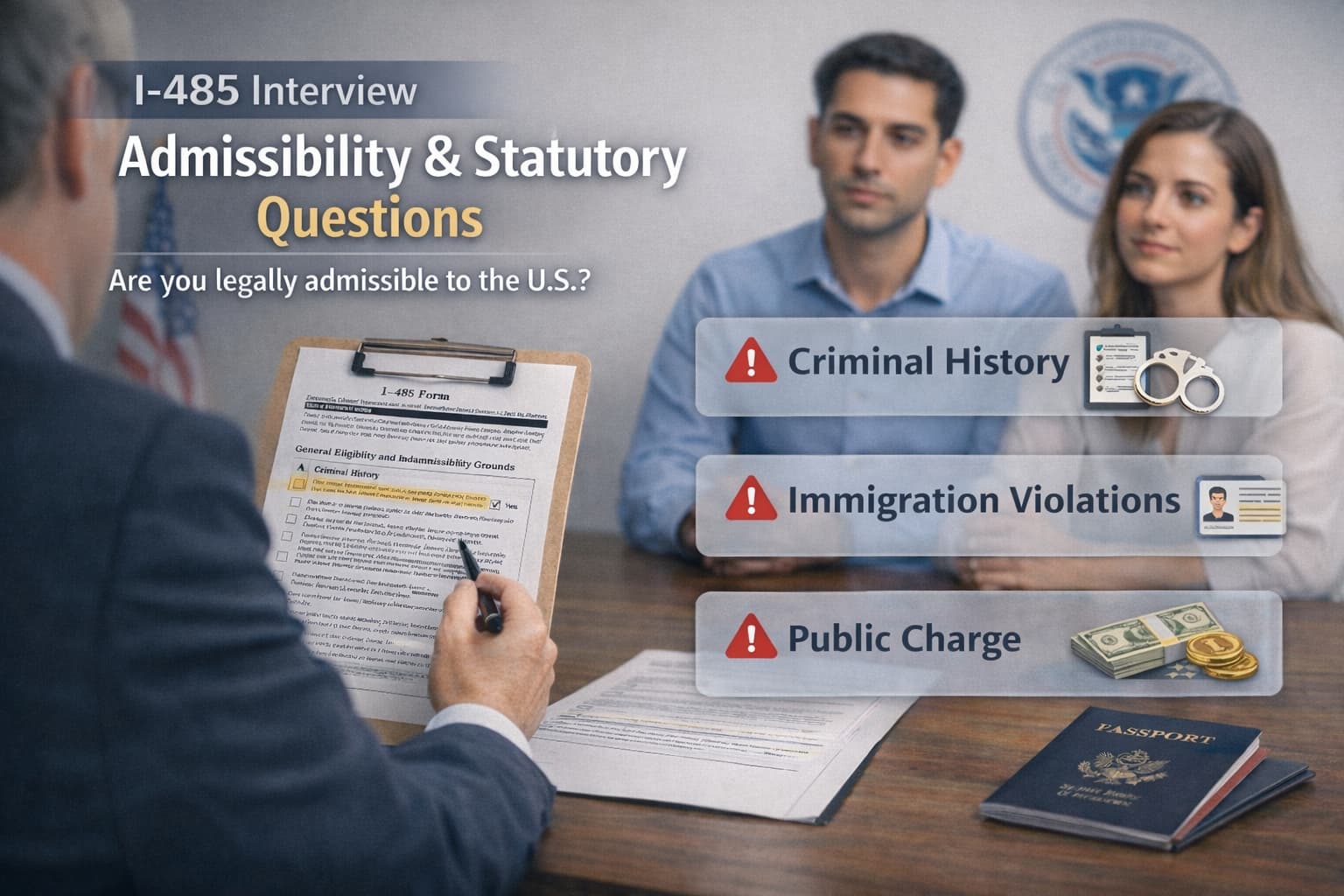
Admissibility Questions: What the Officer Must Confirm Beyond Your Marriage
Beyond the bona fides of your marriage, the officer must confirm that you are admissible to the United States. They will go through the eligibility and inadmissibility section of the I-485 form verbally.
Criminal History
The form asks if you have ever been arrested, cited, charged, or convicted of any crime. You must answer truthfully, even if the charges were dismissed, expunged, or sealed. USCIS background checks are extensive. Certain crimes, particularly Crimes Involving Moral Turpitude (CIMTs) and controlled substance violations, may make you inadmissible.
Immigration Violations
Past immigration violations must be disclosed. For spouses of U.S. citizens, an overstay of a prior visa generally does not prevent adjustment of status, because immediate relatives can adjust despite having been out of status. However, there is an important distinction: if you entered the United States without inspection (for example, by crossing the border without authorization), the situation is fundamentally different. Adjustment of status under INA 245(a) requires that you were inspected and admitted, so entering without inspection typically means you cannot adjust inside the United States unless you qualify under section 245(i), a narrow provision that closed on April 30, 2001 and now reaches only people covered by a petition or labor certification filed on or before that date.
The officer will also ask whether you have ever made a false claim to U.S. citizenship, for example on an I-9 employment form. A false claim generally results in a permanent bar from receiving a green card. However, the law provides a narrow exception: if both of your parents were U.S. citizens, you permanently resided in the United States before age 16, and you reasonably believed at the time that you were a citizen, the bar does not apply. The bar may also be waived in certain categories, including refugee and asylee adjustment. Because the consequences are severe and the exceptions are narrow, anyone with a potential false-claim issue should consult an attorney before the interview.
If You File On or After September 18, 2026, a Broader Public Charge Test Applies
The officer must also consider whether you are likely to depend on the government for basic needs like food, housing, or health care. This is called the public charge test, and the rules behind it change on a fixed date.
Until September 18, 2026, USCIS applies the 2022 rule, which keeps the review narrow. It looks at cash assistance for day to day living, such as Supplemental Security Income or Temporary Assistance for Needy Families, and at long term care paid for by the government. Under that rule most other help does not count against you, including Medicaid outside of long term care, food stamps (SNAP), and housing assistance.
That changes on September 18, 2026. DHS published a rule on July 20, 2026 cancelling the 2022 rule, and on August 18, 2026 USCIS issued the guidance its officers will follow. Under the new standard the officer weighs the five factors Congress named, which are your age, your health, your family status, your assets and financial situation, and your education and skills. The officer also considers the Form I-864 Affidavit of Support signed by your sponsor, along with any other fact the officer finds relevant. That now includes means-tested public benefits, meaning help you qualify for because your income is low. USCIS gives cash assistance for day to day living, housing assistance, food stamps, and financial aid for college as examples. There is no checklist and no single disqualifying item. The officer decides case by case, looking at your circumstances as a whole.
Which standard applies to you depends on when your application is filed, not when it is decided. An I-485 postmarked or filed online before September 18, 2026 is reviewed under the 2022 rule even if USCIS decides it long after that date. An I-485 filed on or after September 18 is reviewed under the new standard.
The timing of the benefits themselves is a separate line. For benefits you received before September 18, 2026, USCIS counts only cash assistance for day to day living and long term care at government expense. For benefits received on or after that date, USCIS may consider any means-tested benefit.
The form changes on the same day, and there is no grace period. Before September 18, USCIS accepts only the 01/20/25 edition of Form I-485. On and after September 18, it rejects that edition and accepts only the new 09/18/26 edition. USCIS has posted a preview of the new edition so applicants and their attorneys can prepare.
One point is worth stating plainly. The guidance describes the test in terms of the benefits the applicant receives. A child born in the United States is a citizen and qualifies for programs like SNAP or MassHealth in their own right. If you are worried about how a citizen child’s benefits will look on your application, ask an attorney before you change anything.
There is also a step that comes after a finding. If public charge is the only reason an officer finds you inadmissible, the officer may invite you to post a public charge bond, which is money held as a guarantee that you will not end up relying on public benefits. You can file the bond form only if USCIS invites you to, in a notice saying it plans to deny your case (formally called a Notice of Intent to Deny). USCIS will not accept a bond from anyone who was not invited.
Handling Red Flags and the Stokes Interview
Certain circumstances can cause a USCIS officer to apply extra scrutiny. These are not automatic grounds for denial, but they require stronger evidence and clearer explanations.
- A significant age difference between spouses.
- A lack of a common language.
- Living in separate residences, even with a documented reason like work or school.
- A very short courtship period before marriage.
- Previous immigration petitions filed by or for either spouse.
If the officer has serious doubts after the initial joint interview, they may conduct a Stokes interview: you and your spouse are separated and asked the same set of highly detailed questions. The officer compares your answers for inconsistencies. Questions become very specific: “What color is your spouse’s toothbrush?” or “What did you each have for dinner last night?” The best strategy is to answer honestly. If you don’t know or can’t remember, say that. A wrong answer that conflicts with your spouse’s is far more damaging than admitting you forgot.
What Happens After Approval: Conditional Residence and the I-751 Deadline
If your marriage was less than two years old at the time your green card is granted (not the interview date), you will receive a conditional green card valid for two years. The officer is not only deciding your current application but is also noting details for your future I-751 Petition to Remove Conditions on Residence.
The I-751 filing window is strict and you cannot afford to miss it. You must file the joint I-751 petition during the 90-day period immediately before your conditional card expires. Filing too early results in rejection. Filing late can terminate your conditional status and place you in removal proceedings.
When USCIS receives a properly filed I-751, it issues a receipt notice that automatically extends your permanent resident status for 48 months while the petition is processed. Current processing times are running roughly three years, so the receipt notice is one of the most practically important documents in the entire process.
Important exception: if you are filing for a waiver of the joint filing requirement because of divorce, the death of your spouse, or because you experienced abuse, you are not bound by the 90-day window. Waiver petitions may be filed at any time before your conditional status expires or removal proceedings are completed.
Adjustment of Status Is Discretionary: Why Preparation Matters More Than Ever
One thing every applicant should understand is that a marriage-based green card is not automatic, even when every requirement is met. Adjustment of status is a discretionary benefit, which means USCIS has the authority to deny an application even if the applicant is technically eligible. A May 2026 USCIS policy memorandum (PM-602-0199) reinforced this principle, directing officers to treat adjustment as an extraordinary form of relief.
What this means for your interview is that thorough, honest preparation is not optional. A genuine marriage supported by strong evidence and a well-prepared couple is the strongest possible position to be in.
Frequently Asked Questions
Can we bring an interpreter to the interview?
Yes. If either spouse is not fluent in English, you may bring an interpreter. The interpreter should be someone who has no personal stake in the outcome of the case, such as a professional interpreter or a community member who is not a close friend or family member, though the officer has discretion to allow someone you know. Both spouses and the interpreter must sign Form G-1256 (Declaration for Interpreted USCIS Interview) at the start of the interview. One important restriction: your attorney cannot serve as your interpreter under any circumstances, even if they speak both languages.
What happens if we forget a specific date during questioning?
It is better to say “I’m sorry, I’m nervous and can’t recall the exact date right now” than to guess and provide an incorrect answer that conflicts with your spouse’s.
Do I need a lawyer for the interview?
While not mandatory, having an immigration attorney present is highly recommended if your case involves any complexities, such as a criminal history, prior immigration violations, or other red flags. An attorney helps prepare you and protects your rights during the interview.
How long does it take to get a decision after the interview?
A decision is sometimes made on the spot, with the officer telling you that your case is approved. In other instances, the case may require further review, and a decision will be mailed to you. Most post-interview decisions arrive within 30 to 90 days, though complex cases can take longer.
What if my spouse has a criminal record?
The U.S. citizen petitioner’s criminal record does not usually make the immigrant spouse inadmissible, unless the crime falls under the Adam Walsh Act, which relates to offenses against minors.
What is the 90-day I-751 filing window?
If you received a two-year conditional green card, you must file Form I-751 during the 90 days immediately before the card expires. Filing too early leads to rejection. Filing late can terminate your status. The exception is waiver petitions (for divorce, abuse, or death of spouse), which may be filed at any time.
Which public charge rule applies to my case?
It depends on when your I-485 is filed, not when it is decided. Applications postmarked or filed online before September 18, 2026 are reviewed under the older 2022 rule. Applications filed on or after that date are reviewed under the new, broader standard and must use the 09/18/26 edition of the form. If you are close to filing, talk to an attorney about the timing.
Does my U.S. citizen child’s SNAP or MassHealth count against me?
The public charge test looks at the benefits you receive. A child born in the United States is a citizen with their own right to those programs. Before you drop a child’s benefits over a green card worry, talk to an attorney.
Let Us Help You Prepare for Your Marriage Green Card Interview
The I-485 interview is not an interrogation designed to trap you. It is an opportunity to tell the story of your life together. Anxiety is normal, but being unprepared or untruthful jeopardizes your entire case.
At Brooks Law Firm, we prepare you thoroughly for every question the officer may ask, help you organize the strongest possible evidence package, and stand by your side during the interview itself. Call us today at (617) 245-8090 or reach out through our online form for a free consultation. Our team speaks English, Spanish, and Portuguese. If you have not filed yet, ask about the September 18 date, because it decides which public charge standard applies to your case.


