

Green Card Renewal: Cost, Timeline, and How To Apply
Your green card has an expiration date, and when it approaches, renewing it on time is one of the most important things you can do to protect your ability to work, travel, and prove your lawful permanent resident status in the United States. The process centers on a single USCIS form, and while most renewals are straightforward, the details matter, especially in 2026, when processing times have increased significantly compared to prior years. If you have questions about your green card or need help with the process, a green card lawyer at Brooks Law Firm can walk you through your options. Call us at (617) 245-8090 to schedule a consultation.
This guide covers everything you need to know about green card renewal in 2026: the form you need, the current government filing fees, how long the process takes, what happens if your card has already expired, and when it makes sense to work with an immigration lawyer.
How To Renew Your Green Card
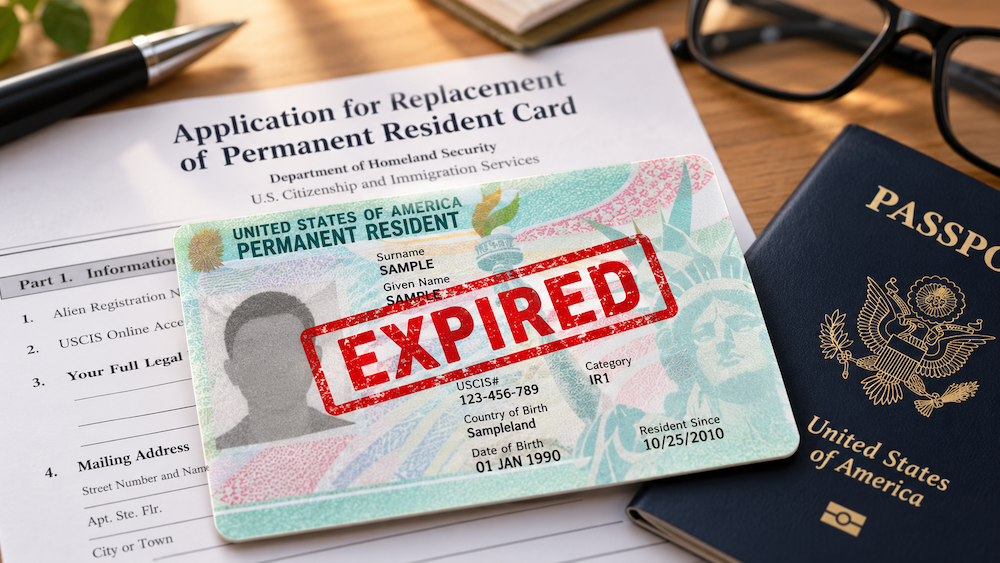
Green card renewal uses Form I-90, officially called the Application to Replace Permanent Resident Card. Despite the name, this is the form USCIS uses for both renewals and replacements. Whether your 10-year card is expiring, has already expired, or was lost, stolen, or damaged, Form I-90 is the correct filing.
USCIS accepts Form I-90 up to six months before your card’s expiration date, and filing early is worth considering given the current processing backlog.
There are two ways to file:
- Online through your myUSCIS account. This is the faster and less expensive option.
- By mail to the USCIS lockbox address listed in the Form I-90 instructions on the USCIS website.
One Important Distinction
Form I-90 is only for standard 10-year green cards. If you hold a two-year conditional green card, typically issued when your marriage was less than two years old at the time of approval, you need to file Form I-751, Petition to Remove Conditions on Residence, not Form I-90. Filing the wrong form wastes both time and money. You can learn more about conditional green cards and the I-751 process in our guide to proving a bona fide marriage for immigration.
The I-90 Form: What You Need To File
Form I-90 is one of the more straightforward USCIS filings, but submitting it correctly the first time matters because mistakes can result in rejection and delays.
Here is what you will generally need:
- A copy of your current or expired green card (front and back)
- A government-issued photo ID
- Payment for the filing fee
- Supporting documents if you are filing for a name change, biographic correction, or replacement of a lost or stolen card (such as a police report for theft)
USCIS will send you a receipt notice (Form I-797C) within two to four weeks of accepting your application. That receipt notice is a critical document, which we cover below.
How Much Does It Cost To Renew a Green Card?
The USCIS government filing fee for Form I-90 in 2026 is $415 for online filing and $465 for paper filing. These amounts were set by the USCIS fee rule that took effect on April 1, 2024, and they remain unchanged in 2026. There is no separate biometrics fee. USCIS folded the previously separate $85 biometrics charge into the base filing fee starting with that same 2024 rule.
The $50 difference between online and paper filing reflects the additional processing USCIS performs on paper applications. Online filing also tends to be faster at the intake stage.
Fee waivers are available in limited circumstances. If you cannot afford the filing fee, you may request a waiver by submitting Form I-912, Request for Fee Waiver, along with your I-90 application. USCIS generally considers fee waivers for applicants who are receiving means-tested government benefits, those who can demonstrate household income at or below 150 percent of the federal poverty guidelines, or those experiencing financial hardship. Fee waiver requests require paper filing and are evaluated on a case-by-case basis.
Premium processing, which is available for certain other USCIS forms, is not offered for Form I-90. There is no way to pay for faster adjudication of a green card renewal.
Related: If you are exploring different green card pathways or want to understand the costs involved in other filings, our breakdown of marriage-based green card costs in Medford, MA covers government fees, medical exam costs, and legal representation for that process.
How Long Does It Take To Renew a Green Card?
This is where green card renewal in 2026 differs significantly from prior years. Processing times have increased substantially.
As of mid-2026, USCIS reports that it takes approximately 10.5 months to process 80 percent of Form I-90 ten-year renewal cases. The median processing time has climbed from roughly 1 month in fiscal year 2024 to over 8 months so far in fiscal year 2026. Some cases resolve faster, and some take longer, but a practical planning range is 8 to 14 months from the date USCIS receives your application to the date your new card arrives.
Here is a general timeline of what to expect after filing:
- Receipt notice (Form I-797C): 2 to 4 weeks after filing
- Biometrics appointment: Roughly 4 to 8 weeks after receipt, at a local USCIS Application Support Center
- Case review and background checks: This is the longest phase, typically several months
- Card production and delivery: 2 to 4 weeks after approval
Because processing times are fluid, you can check the current estimate for your specific filing category using the USCIS processing times tool. You can also track your individual case status at egov.uscis.gov/casestatus using the receipt number from your I-797C notice.
If your case exceeds the posted processing time, you may submit an inquiry through the USCIS Contact Center or, as a last resort, contact the USCIS Ombudsman.
What Happens if You Have an Expired Green Card?
An expired green card does not mean you have lost your permanent resident status. Your status as a lawful permanent resident does not expire when your card does. However, the card itself is the primary document you use to prove that status to employers, airlines, and government agencies, so letting it lapse creates practical problems.
With an expired card, you may face difficulty:
- Proving your work authorization to a new employer during the I-9 verification process
- Re-entering the United States after international travel
- Applying for certain government benefits
- Completing other immigration filings that require a valid green card as supporting evidence
The most important thing to know is that filing Form I-90 triggers an automatic extension of your expired card’s validity. Since September 10, 2024, USCIS receipt notices for properly filed I-90 applications extend the validity of your green card for 36 months from the expiration date printed on the face of the card. Previously, the extension was 24 months.
That means your expired green card, presented together with your I-90 receipt notice, serves as valid proof of your permanent resident status and your authorization to work during those 36 months while USCIS processes your renewal.
If you no longer have your physical green card and need proof of status while waiting for your new one, you can contact the USCIS Contact Center to request an appointment at a local field office, where USCIS may issue you an ADIT stamp (Alien Documentation, Identification, and Telecommunications stamp) in your passport as temporary evidence of your status.
Related: Your permanent resident status also plays a role in other immigration filings. If you are a green card holder who obtained status through asylum, our article on getting a green card after asylum explains the timeline for naturalization and how the asylee one-year backdating rule works.
Renew Your Green Card: When To File and Common Mistakes To Avoid
Filing at the right time and avoiding common errors can save you months of delay.
When to file: USCIS accepts Form I-90 up to six months before your card’s expiration date. Given the current processing backlog, filing as soon as that window opens is a practical choice. Filing earlier than six months before expiration risks rejection.
Common mistakes that cause delays or rejections:
- Filing the wrong form. Conditional residents with two-year cards must file Form I-751, not I-90.
- Submitting an outdated form edition. USCIS periodically updates its forms, and filings made on expired editions are rejected. Always download the current version directly from the USCIS website before filing.
- Incorrect payment. Sending the wrong fee amount, an unsigned check, or using the wrong payment method results in rejection. For online filing, USCIS accepts credit card, debit card, or bank account (ACH) through Pay.gov. For paper filing, USCIS accepts credit or debit card authorization (Form G-1450) or a bank withdrawal.
- Missing or incomplete information. Blank required fields or missing copies of your green card (front and back) will slow your case down.
- Not attending the biometrics appointment. Skipping or rescheduling your appointment at the Application Support Center can add weeks or months to your processing time.
Related: Filing mistakes are especially costly when immigration policy is shifting. If you are also navigating a new green card application for a family member, our article on what the I-485 changes mean for green card applicants covers the September 2026 form revision and the new public charge rule.
Green Card Renewal vs. Applying for U.S. Citizenship
Before you file Form I-90, it is worth considering whether applying for U.S. citizenship through naturalization might be a better use of your time and money, depending on where you are in the process.
If you have held your green card for at least five years (or three years if you obtained it through marriage to a U.S. citizen and are still married and living together), you may be eligible to apply for naturalization using Form N-400. Citizenship is permanent and does not require renewal, and it comes with additional rights, including the right to vote, the ability to petition for a wider range of family members, and protection from deportation in most circumstances.
A renewed green card, by contrast, expires again in 10 years, and you will need to go through this process once more.
That said, not every green card holder is eligible for or ready to pursue citizenship, and renewing your card in the meantime is still important to maintaining valid proof of your status. An immigration attorney can help you weigh the two options based on your specific situation.
Related: If you originally obtained your green card through a family petition, our guide on petitions and visas for parents explains how permanent residents can sponsor certain family members and what the current filing landscape looks like.
When You Should Talk to an Immigration Lawyer About Your Green Card Renewal
Most green card renewals are routine, and many people file Form I-90 on their own without issues. But certain situations benefit from legal guidance:
- You have a criminal record. Any arrest, charge, or conviction, even one that was dismissed or resulted in a continuance without a finding (CWOF) in Massachusetts state court, can complicate an immigration filing. In Massachusetts, a CWOF may still be treated as a conviction for immigration purposes under INA §101(a)(48)(A), and the consequences depend on the specific offense and the immigration context. An attorney can evaluate whether your record creates any risk before you file.
- You are in removal proceedings or have a prior deportation order. Filing Form I-90 does not resolve underlying immigration issues, and it is important to understand how a pending renewal interacts with your case.
- Your green card has been expired for a long time. While USCIS does not penalize you for filing late, a card that has been expired for years may require additional documentation to establish that you have maintained continuous residence and have not abandoned your permanent resident status.
- You are unsure whether you should renew or apply for citizenship. The timelines, costs, and long-term implications are different, and the right choice depends on your individual circumstances.
- You spent extended time outside the United States. Absences of six months or more can raise questions about whether you have maintained your permanent residence, which could affect your renewal or a future naturalization application.
Related: If you are exploring the marriage-based green card process rather than renewing an existing card, that guide covers the full filing sequence, current fees, and what has changed for applicants in 2026.
Talk to Brooks Law Firm About Your Green Card Renewal
Whether your green card is expiring soon, has already expired, or you are weighing renewal against citizenship, the right next step depends on the details of your situation. Brooks Law Firm helps permanent residents across Massachusetts with green card renewals, naturalization, and every stage of the immigration process. Reach out to Brooks Law Firm today to schedule a consultation, and we will give you an honest look at where you stand. Call (617) 245-8090 or contact us online.


