

Denaturalization in 2026: Can You Lose Citizenship?
If you are a naturalized U.S. citizen, or you have a family member who became a citizen through the naturalization process, you may have seen alarming headlines about the federal government moving to revoke people’s citizenship. Those headlines are not unfounded.
Since May 2026, the Department of Justice has filed denaturalization lawsuits at a pace the country has not seen in decades, and the shift has left many naturalized Americans wondering whether their own status could be at risk. If you have concerns about your naturalization or your immigration history, the smartest thing you can do right now is talk to an experienced immigration lawyer before any issue becomes a crisis. Call Brooks Law Firm today at (617) 245-8090 for a free, confidential consultation.
The legal basis for denaturalization is not new. Under 8 U.S.C. § 1451, the government has long had the authority to seek revocation of citizenship that was illegally obtained or procured through fraud, concealment of material facts, or willful misrepresentation. What has changed is how aggressively the current administration is using that authority, and the range of cases it is now pursuing.
Can U.S. Citizenship Be Revoked?
Yes, but only through a specific legal process with significant protections. U.S. citizenship obtained through naturalization can be revoked, but not by executive agencies acting alone. Neither the Department of Homeland Security (DHS) nor the Department of Justice (DOJ) can strip someone of their citizenship without a federal court order. Only a U.S. District Judge has the authority to issue a judgment revoking naturalized citizenship, and the government must prove its case by “clear, convincing, and unequivocal evidence,” a high legal standard that requires the court to find no remaining doubt about the government’s claims.
There are two legal tracks for denaturalization:
- Civil denaturalization under 8 U.S.C. § 1451(a). The government files a civil lawsuit in federal court alleging that citizenship was illegally procured or obtained through fraud. There is no statute of limitations, meaning the government can bring a case decades after the oath ceremony. However, because this is a civil proceeding, the citizen has no right to a government-appointed attorney and no right to a jury trial. The government carries the burden of proof by clear, convincing, and unequivocal evidence.
- Criminal prosecution under 18 U.S.C. § 1425. If the government convicts a naturalized citizen of unlawfully procuring citizenship, the court is required to revoke citizenship as part of the sentence under 8 U.S.C. § 1451(e). Because this is a criminal case, the citizen has the full range of protections: the right to a jury, the right to appointed counsel, and the government must prove its case beyond a reasonable doubt. Criminal denaturalization generally carries a 10-year statute of limitations. Importantly, in Maslenjak v. United States (2017), the Supreme Court unanimously held that the government must show a false statement actually “played some role” in the person’s acquisition of citizenship. Not every misrepresentation is enough; it must be one that mattered to the naturalization outcome.
These safeguards matter. The process is not fast or simple, and it requires the government to meet a demanding evidentiary standard in front of a federal judge. But that does not mean it is something naturalized citizens should take lightly, especially in the current enforcement environment.
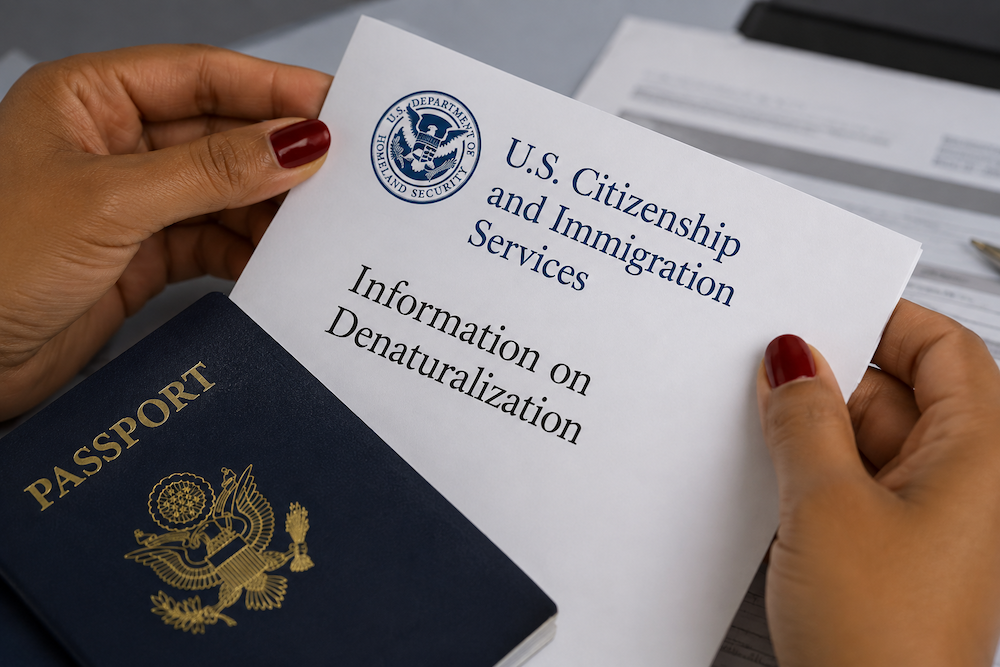
Denaturalization 2026: Why the Landscape Has Shifted
What was once a rarely used legal tool has become a visible enforcement priority. The numbers tell the story clearly.
According to data from the Transactional Records Access Clearinghouse (TRAC) at Syracuse University, the federal government historically filed an average of fewer than one civil denaturalization lawsuit per month, roughly 11 per year between 1990 and 2017. In all of 2025, just eight denaturalization complaints were filed. Then, beginning in May 2026, the pace changed dramatically: at least 15 denaturalization complaints were filed in May alone, followed by 18 more in the first half of June. By July 2026, TRAC identified an additional 21 cases beyond those featured in DOJ press releases, and the DOJ itself has publicly reported filing complaints against batches of individuals in cases involving serious criminal conduct concealed during the naturalization process.
This acceleration did not happen in a vacuum. It traces directly to a June 11, 2025 memorandum issued by the DOJ’s Civil Division, signed by Assistant Attorney General Brett Shumate, which designated denaturalization as one of the division’s top five enforcement priorities. The memo directed DOJ attorneys to “prioritize and maximally pursue denaturalization proceedings in all cases permitted by law and supported by the evidence.”
Can the Government Take Away Citizenship?
The short answer is that the government can seek to take away naturalized citizenship, but it cannot do so unilaterally or without due process. There is an important distinction between what the government can pursue and what a court will actually grant.
The Constitution does not protect naturalized citizenship in exactly the same way as birthright citizenship, but it does guarantee due process. The Supreme Court established decades ago, in Schneiderman v. United States (1943), that denaturalization carries consequences so severe that the evidence must leave no room for doubt. Courts have consistently held that ambiguities in the record should be resolved in favor of the citizen, not the government.
That said, the current enforcement posture has expanded the types of cases the government is willing to pursue. USCIS has reportedly resumed what are called Historical Fingerprint Enrollment (HFE) reviews, using advanced digital verification to compare fingerprints across immigration filings and identify individuals who may have used different identities at different points in their immigration history. Several of the denaturalization complaints filed in June 2026 specifically cited fingerprint analysis as the basis for the government’s claim that the individual had applied for benefits under a false identity.
For naturalized citizens in Massachusetts and across the country, this means the government is actively looking backward through old naturalization files, and technology that was not available when many people naturalized is now being used to flag potential discrepancies.
Reasons for Citizenship Revocation
Under the current enforcement framework, the most common grounds for denaturalization complaints include:
- Fraud or material misrepresentation during the naturalization process. This is the most frequently cited basis. It covers situations where an applicant provided false information on the N-400 application, concealed relevant facts during the USCIS interview, or gave false testimony under oath. Even omissions, such as failing to disclose a criminal history that should have affected eligibility, can form the basis of a complaint.
- Use of a false identity. If someone used a different name, fraudulent documents, or another person’s identity to obtain lawful permanent residence or citizenship, the government can argue the naturalization was based on an identity that did not legally exist. TRAC’s analysis found that false identity and immigration fraud made up the largest category among the cases where the underlying basis could be identified.
- Concealed criminal conduct. If an applicant was involved in serious criminal activity before naturalization, such as drug trafficking, financial fraud, sexual offenses, or other conduct that would have barred them from establishing good moral character, the government can argue that citizenship was obtained by concealing disqualifying information.
- Lack of good moral character during the statutory period. Naturalization requires that applicants demonstrate good moral character during the three or five years before filing (depending on the basis for the application). Conduct during that period that the applicant failed to disclose, or that would have rendered them ineligible, can be grounds for revocation even years later.
- Membership in certain organizations. Under 8 U.S.C. § 1451, if a person joins a group within five years of naturalization that would have disqualified them from citizenship, such as a terrorist or totalitarian organization, that can also serve as a basis for denaturalization.
- Refusal to testify before Congress. Under a rarely invoked provision, a person may be denaturalized if, within ten years of naturalization, they refuse to testify before a congressional committee about subversive activities and are held in contempt.
It is important to understand that most of the cases being filed in 2026 involve serious allegations: concealed criminal convictions, identity fraud, financial crimes, and sexual offenses. The DOJ’s own press releases in July 2026 featured cases involving convictions for healthcare fraud, drug conspiracy, sexual abuse of a child, and identity fraud. However, the enforcement memo’s final category, “any other case the Civil Division determines sufficiently important to pursue,” leaves the door open for the government to expand the types of cases it brings.
DOJ Denaturalization Cases: What the 2025 Enforcement Memo Changed
The June 2025 DOJ memo did not change the law. What it changed was the enforcement intensity and the breadth of cases the government plans to pursue. The memo outlined 10 priority categories of individuals for denaturalization, including:
- National security threats (terrorism, espionage, unlawful export of sensitive technology)
- Human rights violators (war crimes, torture)
- Affiliates of transnational criminal organizations, gangs, or cartels
- Individuals who committed serious criminal offenses not disclosed during naturalization
- Those who committed financial fraud against the United States, including PPP loan fraud and Medicaid/Medicare fraud
- Those who committed large-scale financial fraud against private entities
- Cases involving citizenship obtained through bribery or corruption
- Cases referred by U.S. Attorney’s Offices in connection with other criminal charges
The list is explicitly non-exhaustive. The memo also directed USCIS to ramp up its review of historical files, and reporting suggests that USCIS has been sending specialists to field offices around the country and reassigning staff to focus on denaturalization referrals.
For naturalized citizens who went through the process years or even decades ago, the practical effect is that conduct from the past, particularly anything that was not fully disclosed on the original application, may now receive scrutiny it never received before. The creation of a dedicated Denaturalization Section within the DOJ’s Civil Division during the first Trump administration (2020), its disbandment under the Biden administration, and its functional revival through the 2025 memo reflects how enforcement priorities in this area have shifted with each administration.
How to Protect Your Naturalization
If you are a naturalized U.S. citizen and any of this concerns you, there are concrete steps you can take right now to protect yourself:
Review your Original Naturalization Application
Pull your copy of Form N-400 and look at every answer with fresh eyes. Were all questions answered accurately and completely? Were any arrests, citations, or contacts with law enforcement disclosed? Were all prior names and addresses listed? If you do not have your copy, you can request your immigration file through a FOIA request to USCIS.
Gather and Preserve your Records
Keep copies of your naturalization certificate, your original green card application, court dispositions for any criminal matter (even dismissed charges), tax returns from the statutory period, and any other documents related to your immigration history. If the government ever initiates a review, having organized records makes it far easier to mount a defense.
Understand the Significance of Prior Criminal Matters
If you had any arrests, charges, or convictions before you naturalized, even ones that were dismissed, expunged, or occurred outside the statutory period, consult with an attorney about whether those matters were properly disclosed. In Massachusetts, certain state court dispositions, such as continuances without a finding (CWOFs), may still carry immigration consequences depending on how they are classified under federal law.
Do not Ignore a Notice from USCIS or the DOJ
If you receive any communication from the government related to your naturalization, respond immediately and with legal counsel. In civil denaturalization proceedings, there is no right to a court-appointed attorney, which means you will need to retain your own Citizenship & Naturalization Lawyer to protect your rights.
Consult with an Immigration Attorney Proactively
You do not need to wait for a problem to seek legal advice. If anything about your naturalization process was imperfect, if there was information you were unsure how to answer, if you had a complicated immigration history before applying, a confidential case review can help you understand your exposure and what, if anything, you should do now.
What Naturalized Citizens in Massachusetts Should Know
Massachusetts is home to one of the largest immigrant communities in the Northeast, and the Boston USCIS Field Office processes a significant volume of naturalization applications each year. For naturalized citizens in Medford, Boston, and communities across the Commonwealth, the current enforcement climate is a reason to be informed, not a reason to panic.
The vast majority of naturalized citizens are not at risk. Denaturalization cases remain statistically rare relative to the approximately 25 million naturalized citizens living in the United States, and the cases being filed overwhelmingly involve serious allegations of fraud, concealed criminal conduct, or false identity. Living your life as a law-abiding citizen, paying your taxes, and participating in your community is not the profile these cases target.
But if there is anything in your immigration history that gives you pause, from an old arrest that may not have been disclosed to questions about how a prior attorney handled your application, the time to address it is before it becomes a problem. An attorney can review your file, identify any areas of concern, and advise you on the best path forward.
Citizenship policy has been shifting quickly at the federal level — see our coverage of the administration’s recent birthright citizenship orders.
Dealing with a complicated immigration history is something Brooks Law Firm handles every day. If you are a naturalized citizen with questions about your status, or if you have received any communication from USCIS or the DOJ, reach out to Brooks Law Firm today at (617) 245-8090 for a free consultation. We will give you an honest assessment of where you stand and what steps you should take to protect the citizenship you earned.


