My Family Member Was Detained by ICE in Massachusetts. What Can I DO?
If a family member has been detained by Immigration and Customs Enforcement (ICE) in Massachusetts, there are a few things you can do. Your immediate priorities are locating them, instructing them not to sign any documents, and securing an experienced immigration attorney to demand a bond hearing.
The detention process is intentionally difficult and moves at a startling pace. A person taken into custody in the Boston area is frequently moved to a facility in Plymouth County or transferred out of state to New Hampshire or even Louisiana within a matter of days. This is sometimes a deliberate strategy to disrupt access to family and legal counsel.
But a detention is not a deportation order. With swift and informed legal action, we can intervene. We will fight to secure a bond hearing, challenge the basis of the detention itself, and begin building a strong defense for their right to remain in the United States.
If you are unsure where your relative is or have been told a transfer is imminent, call our experienced Massachusetts immigration attorney now. Our number is (617) 245-8090.
Key Takeaways for Families of ICE Detainees in Massachusetts
- Locate your loved one and tell them not to sign anything. Use the ICE Online Detainee Locator System first, but be prepared to call detention facilities directly, as transfers happen quickly and are designed to disrupt legal access.
- Eligibility for a bond hearing is not guaranteed. Federal law distinguishes between discretionary detention, where a bond is possible, and mandatory detention for certain criminal convictions, which requires a more complicated legal challenge.
- Preventing an out-of-state transfer is a primary goal. ICE frequently moves detainees from Massachusetts to distant states, which severely complicates their legal defense and separates them from family support.
Step 1: Locating Your Family Member Immediately
The primary tool for this is the federal government’s own system, but it is not foolproof.

Using the Online Detainee Locator System (ODLS)
The official starting point is the ICE Online Detainee Locator System (ODLS). To use it effectively, you will need one of two sets of information:
- The Alien Registration Number (A-Number): This is a nine-digit number. If you know it, this is the most accurate way to search. You will also need their country of birth.
- Biographical Information: If you do not have the A-Number, you may search using their full legal name, date of birth, and country of birth. Be aware that the system requires an exact match to whatever an ICE officer entered, so try variations in spelling if your first search fails.
Understand that there is a delay. A person arrested this morning might not appear in the ODLS for 24 to 48 hours. Do not panic if they are not there immediately, but do not stop looking.
Calling Local Massachusetts Facilities Directly
If the ODLS does not yield results, you must begin calling detention centers. Keep a notebook to log every call: who you spoke to, what they said, and the time. In Massachusetts, the key facility is:
- The Plymouth County Correctional Facility: This is the primary location where ICE houses detainees in the Commonwealth. It is a county jail that contracts with the federal government to provide bed space.
ICE also frequently transfers people to other New England hubs, such as the Strafford County Department of Corrections in New Hampshire. More concerning is the transfer pipeline to southern states like Texas and Louisiana, where access to legal help dwindles and the immigration courts are notoriously rigid. An attorney may be able to take steps to halt these transfers, but only if they are retained quickly.
Step 2: Do Not Sign Anything
Once you make contact with your loved one, you must deliver a clear, urgent message: Do not sign any paperwork without a lawyer reviewing it first.
ICE officers are trained to use the confusion and fear of an arrest to their advantage. They will frequently pressure a detainee to sign a document for Voluntary Departure, presented as the fastest way out of jail. It is not. This form, such as Form I-274, is a waiver of fundamental rights. Signing it gives up the right to a hearing before an immigration judge and effectively serves as a self-deportation order.
Undoing a signed voluntary departure agreement is exceptionally difficult. The person could be on a plane and removed from the United States before a legal challenge is even filed.
The right to remain silent and the right to an attorney are cornerstones of our justice system. Refusing to sign a document you do not understand is not obstruction; it is the exercise of a protected right. As the Massachusetts Attorney General has advised, residents have the right to refuse to sign documents they do not understand, even when facing pressure from federal agents.
Step 3: Understanding Mandatory vs. Discretionary Detention
Once your family member is located, the next step is to determine if they are even eligible for release on bond. Federal immigration law splits detainees into two broad categories.
The Difference Is in the Law
- Discretionary Detention: Under Section 236(a) of the Immigration and Nationality Act (INA), most individuals are eligible for a bond hearing. In these cases, we go before an immigration judge and argue for their release.
- Mandatory Detention: Under INA § 236(c), Congress has mandated that individuals with certain types of criminal convictions be detained without a bond hearing while their immigration case proceeds. This typically includes convictions for aggravated felonies, certain crimes involving moral turpitude, or drug offenses.
Recent federal laws have expanded the reach of mandatory detention. For instance, legislation like the Laken Riley Act, signed into law in early 2025, broadened mandatory detention to include people who are merely arrested for or charged with certain theft-related offenses, even without a conviction. This means that a simple shoplifting charge, even if it is eventually dismissed, might be used by ICE as grounds to hold someone without bond.
Challenging Mandatory Detention
Even if ICE claims detention is mandatory, an experienced lawyer does not simply accept it. We must immediately obtain your loved one’s complete immigration and criminal history. We may argue that a specific Massachusetts conviction does not neatly fit the federal definition of a crime that triggers mandatory detention.
This is a difficult legal argument known as the categorical approach, where we compare the elements of the state crime to the federal standard. Successfully making this argument makes the difference between indefinite detention and eligibility for a bond hearing.
Step 4: Securing Release—The Bond Hearing Process
For those eligible for discretionary detention, the next objective is securing their release through a bond hearing. An immigration bond is money paid to the government as a guarantee that the person will attend all future court hearings.
How the Process Unfolds
First, an ICE officer makes an initial custody determination, typically setting an unreasonably high bond or denying it altogether. This decision is documented on a form I-286.
We then file a request for a Bond Redetermination Hearing before an Immigration Judge, which in this region typically takes place at the Boston Immigration Court located in the JFK Federal Building.
At the hearing, we must prove two things to the judge:
- Your family member is not a danger to the community. We demonstrate this with evidence of good moral character, letters of support from family and community members, proof of rehabilitation if there are past convictions, and any other positive equities.
- Your family member is not a flight risk. We establish this by showing deep ties to the community in Massachusetts. This includes evidence of stable employment, property ownership or leases, the presence of U.S. citizen children enrolled in local schools, and long-term residency in the area.
Judges are dealing with crowded dockets, and a disorganized or incomplete bond presentation will not succeed. A comprehensive, well-documented bond package is essential to persuade a judge to grant release on a reasonable bond.
Be prepared for the financial reality: unlike in criminal court, immigration bonds must be paid in full to an ICE office. There are no 10% payments to a bail bondsman. Bond amounts in the Boston area typically range from $5,000 to $15,000, though the statutory minimum is $1,500.
Massachusetts-Specific Protections and Risks
Lunn v. Commonwealth: A Shield Against Local Collusion
A landmark 2017 decision by the Massachusetts Supreme Judicial Court, Lunn v. Commonwealth, provides significant protection. The court ruled that state and local police officers in Massachusetts do not have the authority to hold a person in custody based solely on an ICE civil detainer request after their state criminal matter is resolved.
If your relative is being released from a local jail after posting bail or finishing a sentence, the jail guards may not legally hold them for extra time just so ICE can come and pick them up. While this does not prevent ICE from waiting outside the jail, it stops local law enforcement from acting as an extension of federal immigration enforcement.
The High Risk of Out-of-State Transfers
The greatest risk to any ICE detainee in Massachusetts is being transferred out of state. Because ICE has limited detention space here, it frequently moves people hundreds or thousands of miles away. A transfer severely disrupts the attorney-client relationship, cuts off family contact, and leads to worse case outcomes.
Fighting to keep a case in Boston is an early-stage goal. Filing an emergency petition for a writ of habeas corpus in federal court is a tool to challenge unlawful detention or to try and halt a pending transfer.
Long-Term Defense: Stopping Deportation After Release
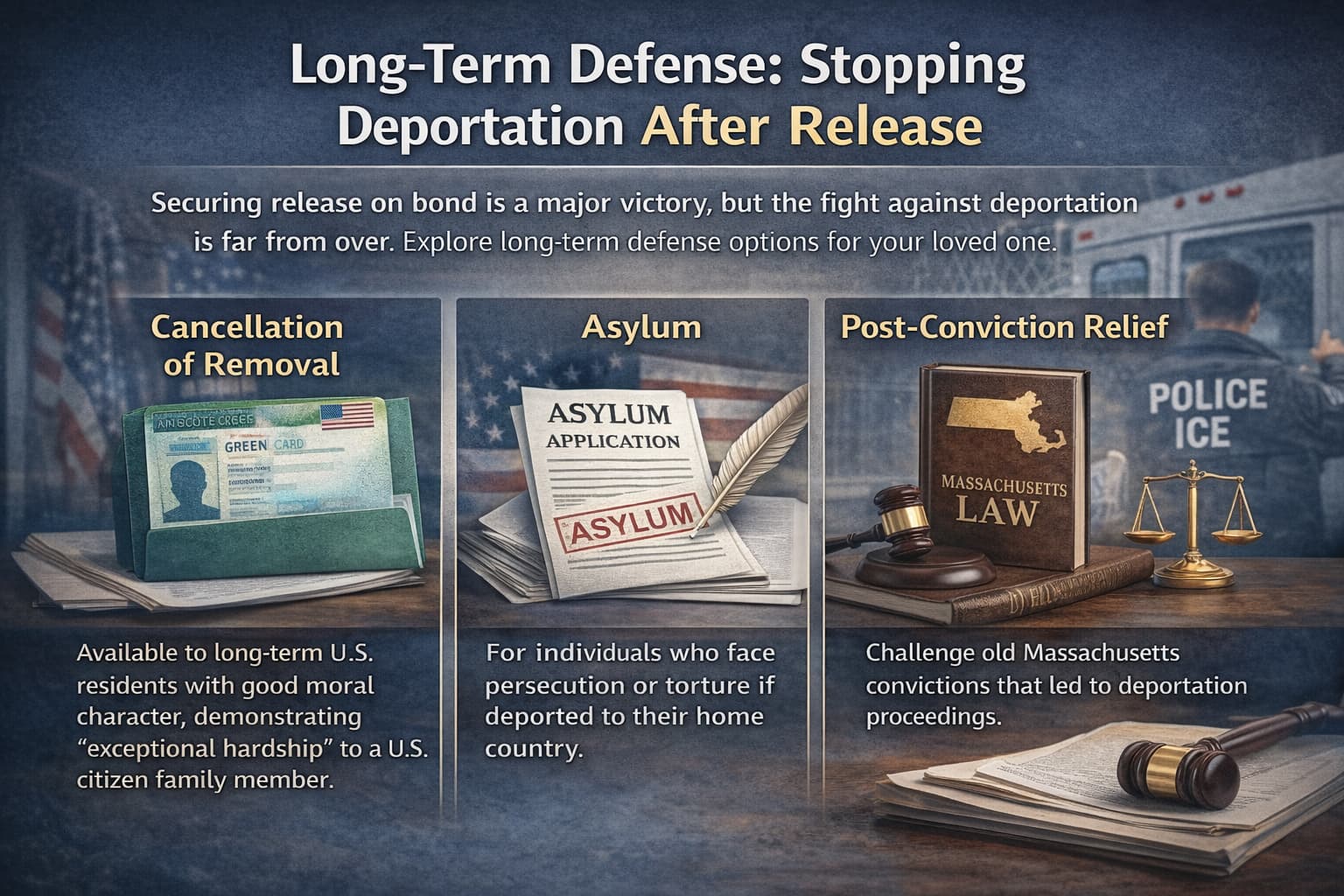
Securing release on bond is the first major victory, but the deportation case must still be fought. Several forms of relief are available, depending on the specifics of their case:
- Cancellation of Removal: This is for individuals who have been in the U.S. for at least 10 years, have good moral character, and demonstrate that their removal would cause “exceptional and extremely unusual hardship” to a U.S. citizen or permanent resident spouse, parent, or child.
- Asylum: If your loved one fears persecution or torture if they are returned to their home country, they may have a claim for asylum.
- Post-Conviction Relief: If the immigration case is based on an old Massachusetts criminal conviction, we will investigate. Under the Supreme Court ruling in Padilla v. Kentucky, criminal defense attorneys have a constitutional duty to advise non-citizen clients about the immigration consequences of a guilty plea. If their previous attorney failed to do so, we will seek to go back to state court, vacate the conviction, and eliminate the basis for deportation.
FAQ for ICE Detention in Massachusetts
Can I visit my family member at the Plymouth County House of Correction?
Yes, but the facility has strict rules. All visitors need a valid government-issued ID and must be on the detainee’s approved visitation list. The primary method of contact is usually video visitation, so you should check the facility’s specific and most current policies before traveling there.
What happens to my relative’s car or apartment if they are detained?
ICE is not responsible for securing a detainee’s personal property. If their car was impounded or their belongings are in an apartment, you will need to manage these affairs. You may need to obtain a limited power of attorney from your detained family member to access their bank accounts, deal with landlords, or retrieve a vehicle.
My relative has a Green Card. Can ICE still detain them?
Absolutely. Lawful Permanent Residents (Green Card holders) are placed into removal proceedings and detained if they are convicted of certain crimes that are classified as deportable offenses under immigration law, such as aggravated felonies or crimes involving moral turpitude.
ICE came to my house looking for someone else but took my relative. Is that legal?
This is known as a collateral arrest. While ICE agents claim the authority to arrest any person they encounter whom they believe lacks immigration status, the legality of the encounter itself is challengeable.
If agents entered your home without your consent or a judicial warrant (a warrant signed by a judge, not an administrative warrant signed by an ICE officer), any arrest made inside is likely unlawful.
Let’s Help Bring Your Loved One Home
Every hour that your family member remains in ICE custody is an hour the government is using to build its case for removal.
Do not wait for immigration officials to “sort it out.” They have one objective. We have another: to bring your family member home.
Our practice focuses on the intersection of Massachusetts law and federal immigration enforcement. We understand the local facilities, the courts, and the strategies needed to fight back.
Let’s get started. Call Brooks Law Firm immediately at (617) 245-8090.